


Urban sustainability is at the heart of the global push for low emissions and net zero. Existing developments have already lowered the environmental impact of many of our planet’s cities, with the average citizen producing around 35% less carbon dioxide than those living in rural areas. We shouldn’t get complacent, though. There’s a long road ahead to arrive at first-class urban sustainability.
This is where purpose-led tech brands come in. From transport to building development, the sustainable names in business are shaping our towns and cities for the future. Let’s take a closer look at how they’re accelerating the urban impact.
How on earth can tech brands shape urban sustainability?
Within urban landscapes purpose-led brands are using technology to rethink our ways. By creating platforms that integrate with our towns and cities, they’re paving the way for a more eco-friendly future that flows intuitively.
Urban sustainability is impelled to move quickly. This isn’t just a wholesome ‘nice to have’. We’re at a worrying crossroads in terms of climate change and rapid progress in cities is essential if we’re going to meet climate targets and improve folk’s quality of life.
Tech brands are uniquely positioned here. In an increasingly digital world, they can combine infrastructure and data to influence how millions of people move, live, work, and consume energy every single day. Let’s take a closer look at how these brands are having a positive impact on our urban spaces.
We’ll have a peek at three crucial areas: public transport, decision making, and smart buildings.
Examples of brands leading the way
1. Enhancing UX on public transport
A key focus of brands developing tech for sustainable cities is transport. This weighty sector produces almost one fifth of the planet’s CO2, and reducing its footprint is essential to mitigating the risks of climate change.
Unsurprisingly, sustainable urban mobility is a hive of purpose-led brands beginning to dominate the space. There’s an increasing number of eco-focused companies developing EV tech, for instance, Canoo, Proterra, and Irizar e-mobility.
In the UK, Alexander Dennis Limited (ADL) is a purpose-led organisation that’s having a major impact on urban transport. They’re focused on manufacturing and supplying zero-emission buses to towns and cities across the country, reshaping urban sustainability by bringing EV public transport to the masses.
Alongside EVs, there’s a fleet of tech focused on the user experience (UX) of public transport. Its goal is to make travelling by bus, train, or tube more convenient and straightforward so that a rising number of people leave their cars behind.
The account-based ticketing offered by Littlepay, as one example, brings a seamless ‘tap in’ approach to country-wide public transport. Their UX-led innovation has a direct impact on accessibility, making systems easier to navigate for everyone, including those with disabilities or language barriers.

Another strong example of a purpose-led tech brand shaping eco-friendly public transport is Citymapper. While best known as a journey-planning app, Citymapper actively prioritises low-carbon routes, integrates real-time public transport data, and nudges users toward walking and cycling where possible.
2. Data-led decision making
Purpose-led tech brands are shaping cities through data-driven urban development. From smart energy grids to energy-efficient buildings, data allows brands and city planners to make more informed decisions that reflect sustainability goals.
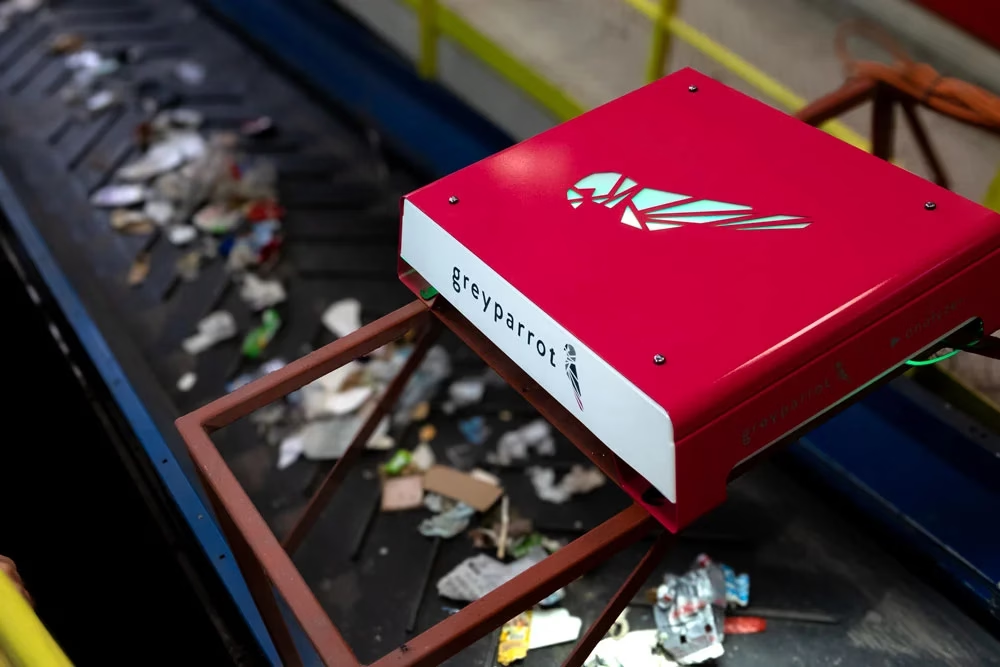
Greyparrot AI, for instance, has developed software that helps waste managers recycle more and send less to landfill. By using their tech, organisations can prioritise sustainable waste management and create systems that are entirely transparent from end-to-end. It’s an example that shows while Generative AI has an ambiguous role to play in a sustainable future, Traditional AI can be powerful.
There are also sustainable data analytics groups, like NetZero Group. Their purpose is to help organisations monitor, report, and reduce their carbon footprint, helping individual industries within urban settings take better accountability for their eco-impact.
Data is often viewed as a tool for optimisation but it’s also a marketing asset – especially in the sustainability sphere. Brands that can quantify and visualise their sustainable technology impact (like lower energy use and reduced emissions) can back up claims and provide proof of their eco-chops to customers. This is essential to avoid greenwashing, and a key focus of our marketing services, too.
3. Sustainably smart buildings
Governments may be pushing for more building development but this isn’t always sustainable. In fact, buildings are responsible for almost 40% of global emissions, much of which is tied up in inefficient heating, cooling, lighting, and construction practices.
Fortunately, purpose‑led tech brands are stepping into this space with innovations to reshape the industry, without compromising on the tricky need for new buildings.
Atamate, for example, has developed building management software with a focus on sustainability. Their tech enables automated control of energy-consuming systems (like heating and cooling) to improve efficiency, and key data insights into building performance, including air quality and electricity consumption.
With such a huge percentage of emissions originating from this sector, we don’t have room for half-hearted sustainability (the type that’s more about swagger than it is about driving change). We need purpose-led brands to give our planet a voice, moving beyond surface-level adjustments to create real impact .
Moving from greenwashing to sustainable impacts
One of the differences between classic organisations and purpose-led brands is authenticity. Dig deeper, and you’ll find that sustainability runs deep, through everything they do, not just some superficial quick wins
Purpose-led brands can back up their claims with evidence, too. They have data on the environmental impacts of their products (and often their businesses as a whole!) and the case studies to prove they work.
They care about kicking greenwashing out of the sustainable industry and want to catalyze real change for our urban spaces.
To have the largest impact, they’re also likely to focus on sustainable-focused marketing. These are strategies that don’t just sell, but educate, engage, and inspire audiences to join the eco-revolution. This is so crucial when it comes to widespread adoption and a must if we want to see impactful development in our urban spaces.
When done well, marketing can amplify the positive effects of these innovative brands and transform an entrepreneur’s idea into the future of our societies.
Take a look around you
Our planet relies on many things to secure its future – and sustainable urban development is an important part of the puzzle. As the threat of climate change looms, it’s reassuring to see so many brands vying to update the urban landscape. The next time you’re out and about, take a look around you, we bet you’ll see more pioneering systems popping up. And the more smoothly these are integrated into your movement and experience, the better.
At Akepa, we work with sustainable brands to bring their mission voices to the masses. We know just how driven purpose-led entrepreneurs are and the significant impacts they can have on our society – and the wider planet as a whole. If you’re one of those looking to get your mission going then take a look at our sustainable marketing services to learn more.




Leave a Reply