


You’d think it would be simple to take the steps to tackle climate change.
The planet’s heating up, which means civilization is under threat, and so we must do something or risk extinction. Let’s go. Onwards!
Oh no but stop right there. That’s not how it works! Just agreeing that climate change is happening is hard, never mind finding adequate solutions that don’t involve making absurdly distant 2050 pledges. And all the while, through grand meetings of world leaders, GHG emissions keep going up when they should be plummeting.
What’s going on? Well, the factors making climate action a Kafkaesque quest for salvation are myriad. However, one of the complicating factors is climate lobbying. It’s a dark influence that’s obscured from the senses of most non-policymaking people who care about climate change. That’s what we’re going to look at in this post – with some examples of this terrible behaviour.
A simple definition of climate lobbying:
Lobbying is about putting pressure on governments and regulatory bodies to influence policies and laws. It follows that climate lobbying is about applying that pressure to influence policies towards climate change. For example, trying to prevent or water-down:
- The phase-out of fossil fuels and blocking new drilling licenses.
- Emissions caps and enforcing genuine net-zero targets (rather than just distant aspirations).
- Tax credits and subsidies for electric vehicles and renewable energy infrastructure.
- Binding legislation to curb single-use plastics and hold corporate polluters accountable.
- Carbon pricing mechanisms, like carbon taxes or cap-and-trade systems.
- Cuts to subsidies historically handed out to the oil and agriculture industries.
- Data centre controls to protect people from effects of the booming sprawl.
Normally the lobbyists are those in powerful and influential positions who stand to lose from the climate action in question – especially financially – for example Big Oil, which makes hundreds of billions in profits each year from fossil fuels and would be threatened by their phase-out. The fact that climate change affects everyone – including lobbyists – doesn’t matter.
Climate lobbying can also happen to positively influence policies on climate change. But in this post, we’re referring to the lobbying that aims to stifle progress.
Now, let’s take a look at some examples of climate lobbying that have been exposed in the real threatened world.
How is lobbying achieved?
You might wonder what a lobbyist does to achieve results? Let’s say you were a sinister lobbyist type working on behalf of Big Oil. Here are a few things you might do:
- Wining & dining: You secure private meetings, VIP dinners, and all-expenses-paid “retreats” with key lawmakers to casually explain why a new solar subsidy is actually a terrible idea for the economy.
- Blank cheques: You funnel massive campaign contributions, often through byzantine Political Action Committees (PACs or Super PACs) or dark money groups, to ensure the politicians who vote the preferred way have the war chests they need to stay in power.
- Revolving doors: You hire former politicians and regulators to lobby their old buddies, exploiting those established relationships. Conversely, you subtly dangle the promise of a lucrative seven-figure corporate job to current public officials once their term ends. Many former politicians become lobbyists.
- Writing laws: Politicians are busy people. A generous lobbyist will draft the text of a bill or an amendment – complete with carefully confected loopholes – and hand it to a friendly legislator to propose as their own brilliant idea.
- Funding faux-science: You bankroll industry-friendly think tanks and researchers to churn out white papers that conveniently cast doubt on climate data or aggressively exaggerate the costs of transitioning to green energy.
- Astroturfing: You set up fake “grassroots” citizen groups with wholesome, patriotic-sounding names (like “Citizens for Energy Freedom”) to manufacture the illusion that everyday voters are desperately demanding more oil drilling.
- Online meddling: You establish fake profiles to infiltrate popular social media and discussion forums, like Reddit. Discrediting lifestyles like veganism and spreading misleading narratives. You mayeven post scandalous 1-star reviews or even be involved in the creation of full-scale websites devoted to discrediting.
Now to some examples of lobbying in practice.
Example 1: Big Oil at COP29
The Conference of The Parties (COP) are the most important international climate conferences on the planet. At these meetings, game-changing international agreements should be made to keep temperature rises within the limits of the Paris Agreement (1.5°C). The omnipresence of Big Oil has tainted these events in recent years and the dark shadow was especially conspicuous at the 29th Conference of The Parties in Azerbaijan.
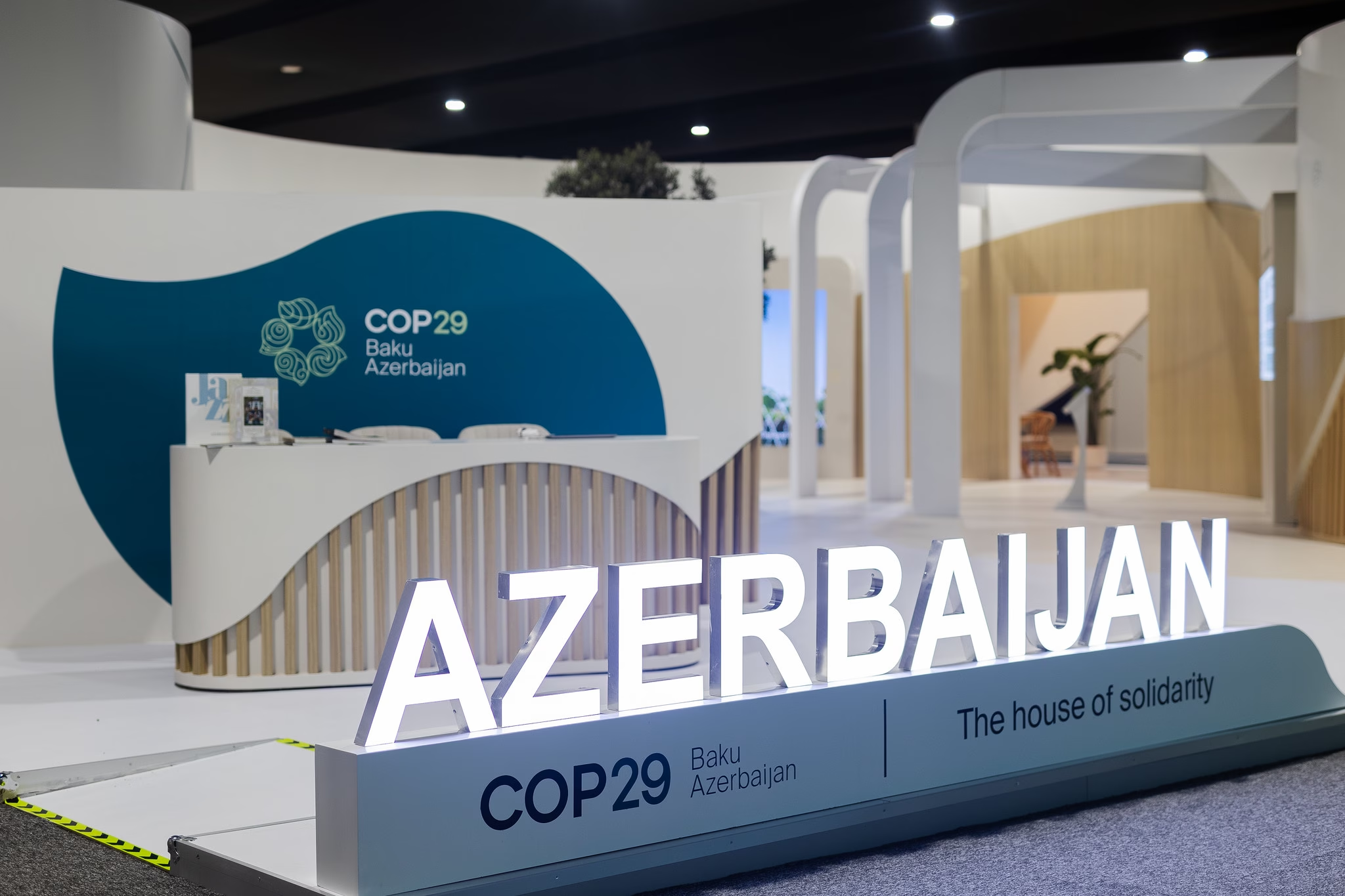
During his ceremonial opening speech the president of Azerbaijan and COP29 host, Ilham Aliyev claimed oil and gas are a ‘gift of God’. His deputy energy minister – and also the chief executive of COP29 – Elnur Soltanov, was caught on film agreeing to facilitate oil deals at the negotiations.
Scenes! Then, during the actual conference, at least 1,700 coal, oil, and gas lobbyists were given access – outnumbering actual delegates from almost every country. This all sounds like peak-Ianucci satire but sadly it’s real-life at a really important conference.
So, what exactly do 1,700 fossil fuel lobbyists do at a climate conference? They aren’t there to admire the renewable energy pavilions. They actively infiltrate national delegations, shape the wording of draft texts, and push “false solutions” like Carbon Capture and Storage (CCS) – largely unproven technologies strategically championed to let them keep extracting oil indefinitely. The effect is a deliberate watering down of the final agreements. Instead of hard commitments to “phase out” fossil fuels, the lobbying architecture makes sure we end up with weak, non-binding compromises like “transitioning away” on undefined timelines, packed with loopholes that guarantee business as usual.
At last year’s COP30 in Brazil, only around 1,600 fossil fuel lobbyists turned up. A slight drop from the number at COP29 but still an influx that’s way more numerous than it should be. The number still outnumbered the delegation from any nation apart from Brazil.
Looking ahead to COP31 in Antalya, Turkey – let’s hope that decline continues because transformative agreements are very difficult to achieve under the interference of Big Oil.
Example 2: Gamifying pollution: Toyota’s anti-EV arcade
You might associate Toyota with eco-friendly machines like the Prius halo of the 2000s, but behind the scenes, the world’s largest automaker has consistently ranked as one of the most obstructive companies globally regarding climate policy. Their recent tactics, however, sound like a dystopian sci-fi plot.
In late 2025, it was exposed that Toyota was using an internal platform called “Toyota Policy Drivers” to literally gamify corporate lobbying for its US workforce. Through retro-style video games, employees were incentivized with points and prizes to swallow anti-EV propaganda and persistently lobby their federal and state representatives.

What were they lobbying for? To aggressively push back against Biden-era auto emissions targets and to fight California’s groundbreaking mandate to phase out the sale of new gas-powered cars by 2035. By turning environmental obstruction into an office arcade game, Toyota weaponized its own staff to protect its dominance in the combustion engine and hybrid markets at the expense of genuine zero-emission progress.
For more of this kind of thing, Severance Series 3 is expected to begin filming in April 2026 and wrap by December 2026.
Example 3: Big Meat’s methane smokescreen and “agricultural exceptionalism”
When we talk about emissions, we usually picture smoke billowing into the sky from chimneys but the global food system – specifically animal agriculture – is responsible for a massive chunk of man-made methane, a greenhouse gas over 80x more potent than CO2 in the short term. Giant meat and dairy conglomerates, like JBS, pump out more greenhouse gases annually than some entire developed nations.
To protect their colossal profits, Big Meat – or Big Ag if you prefer – relies on a lobbying strategy of “agricultural exceptionalism” – convincing policymakers that they shouldn’t be subject to the same climate rules as everyone else. Over the past few years, meat-producing nations and corporate lobbyists have been caught red-handed pressuring the UN’s Intergovernmental Panel on Climate Change (IPCC) and the Food and Agriculture Organization (FAO) to strip language from landmark climate reports that recommend reducing meat consumption or shifting toward plant-based diets.
At the national level in the US and EU, they pour millions into lobbying to ensure that any agricultural emissions targets remain entirely voluntary, ensuring an “all-carrots-and-no-sticks” approach that lets them keep polluting without penalty.
Some of the arguments against plant-based meat – that it’s ultra-processed and so on – have been shepherded into the public consciousness by Big Meat. And while Big Meat may lie behind the creation of new terms like ‘frankenfoods’, the EU’s ban of over 31 “meaty” terms like “steak,” “chicken,” and “bacon” on plant-based labels to protect traditional meat designations is said to be driven by intense lobbying on the EU’s agricultural committee. Most people buying products aren’t confused by these labels.

Example 4: Sabotaging the UK’s Windfall Tax with absurd loopholes
Following the 2022 energy crisis, Big Oil companies were posting record-breaking, eye-watering profits. In response, the UK government attempted to introduce the Energy Profits Levy – a windfall tax on North Sea oil and gas operators to help folk struggling with massive energy bills.
Enter the lobby. The industry’s trade body, Offshore Energies UK (OEUK), went into overdrive. Through intense pressure, they secured a “fiscal forum” that effectively allowed them to advise the government on their own tax regime. As a result, they managed to carve out massive legislative loopholes, including an investment allowance that offered a near-total tax break for companies that reinvested their profits into new oil and gas extraction. Yes, you read that right: a tax designed to address a crisis exacerbated by fossil fuels was manipulated into subsidizing more fossil fuel drilling.
Example 5: Big Tech’s data centre smokescreen
Big Tech companies are eager to talk about their green credentials but when it comes to the massive energy demands of their rapidly sprawling AI data centres, transparency suddenly becomes a dirty word.
In April 2026, an investigation by The Guardian and Investigate Europe revealed that US tech giants – including Microsoft and industry groups representing giants like Amazon, Netflix and Meta – successfully pressured the EU to keep the environmental toll of their data centres a secret. They achieved this by getting a legally questionable confidentiality clause inserted almost word-for-word into an EU energy efficiency regulation from the European Commission.
The result is that the public, researchers, and journalists are blocked from seeing key performance indicators – like the actual pollution and energy consumption – for individual data centres. Instead, they’re left with nebulous, aggregated national-level summaries. Even Freedom of Information requests are denied under this new corporate-friendly loophole, which legal experts warn likely violates the Aarhus Convention on public access to environmental information.
It’s a worrying case of prioritizing the lucrative, meteoric build-out of AI infrastructure while kicking the climate into the long grass. Publicly Big Tech might champion clean energy but behind closed doors, lobbying ensures that real footprints are hidden in the clouds.
This is why it’s naive to expect sensible, straightforward and strict regulation for the AI industry – despite the frightening speed of development and the looming impact on people’s lives. Lobbying from omnipotent companies zaps the inconvenience away.
Extinction or survival? Extinction please!
So there we go: navigating the climate crisis should be a straightforward yet rocky road from A to B. It’s not. There’s a massive labyrinth in the way, which we’re building ourselves and enlarging all the time. We might not figure the way out but, in the end, powerful lobbyists and those entertaining them should remember that a future with an out-of-control climate will affect everyone negatively; nobody gets away. Humans can be shockingly short-sighted.
At Akepa, what we can do is raise a bit of awareness on this very murky topic. We hope we’ve shed some light. And we’ll be keeping this article up to date with the latest lobbying cases to make sure it’s as reflective as possible on what’s really happening out there.




Leave a Reply