


AI washing isn’t about teaching a sophisticated robot to do your laundry, nor is it about optimizing your dishwasher’s cycle through neural networks. No, much like its older, equally deceptive sibling, greenwashing, it’s far more insidious than that.
We are living through a gold rush of artificial intelligence. Ever since generative AI broke the mainstream, the phrase “AI-powered” has been slapped onto everything from electric toothbrushes to basic invoicing software to fizzy beverages. But here at Akepa, where we’re familiar with shadier sides to corporate marketing, we’ve started noticing a troubling parallel.
AI washing is when an organization or brand spends more time and money marketing their products, services, or corporate restructuring as “driven by Artificial Intelligence” than they do actually developing or implementing meaningful AI tech. It is a performance of innovation without any of the mechanics of innovation.
At its simplest, AI washing can be a subtle branding trick. Think of a standard data-sorting algorithm that a company has used since 2015, suddenly repackaged in 2026 as “proprietary machine learning.” It’s not an outright fabrication but it is deliberately trying to guide us away from the reality of how basic that software actually is. On a much larger scale, however, AI washing can affect corporate culture, investor relations, and human livelihoods in alarming ways.
The investor bait: chasing the dot AI bubble
To understand why AI washing is everywhere right now, we have to look at the money. In the late 1990s, businesses discovered they could exponentially inflate their valuation simply by appending “.com” to their name. Today, companies are doing the exact same thing by sprinkling the magic letters “AI” into their pitch decks and press releases, or slapping .ai onto their website domains.
Regulators have caught on. The SEC has already started treating AI washing as a material misrepresentation under securities law, imposing hefty civil penalties on companies that mislead investors about their technological capabilities. When a brand boasts about an app or even a beverage being “co-created with artificial intelligence” but cannot provide a shard of evidence regarding how the AI was actually utilized, they are AI washing. They are exploiting a buzzword to grab attention, secure funding, and drive up stock prices, operating under the assumption that the average person won’t look under the hood.
The human cost of corporate scapegoating
This brings us to one of the most troubling evolutions of the phenomenon. AI washing has transcended consumer marketing and seeped into corporate restructuring. Specifically: layoffs.
In recent times, a dystopian trend has emerged among tech giants and corporate conglomerates. When faced with the need to downsize, bosses have begun blaming mass layoffs on “the productive capabilities of AI” and its ability to replace human workers. It sounds incredibly forward-thinking and inevitable, doesn’t it? It paints a picture of a company striding toward a hyper-efficient, futuristic utopia.
So confident are the people in control – that other people, somehow, get thrilled about AI taking jobs – they flaglantly boast about it. In a recent interview with Fortune, for example, the CEO of software firm IgniteTech openly bragged about laying off 80 percent of his staff to force an “AI-driven” restructuring, proudly insisting he would do it all over again. Similarly, fintech giant Klarna recently boasted that its AI assistant was doing the equivalent work of 700 full-time human customer service agents. Artisan’s ‘Stop Hiring Humans’ billboards whipped-up so much human excitement about the potential job losses that they went viral.
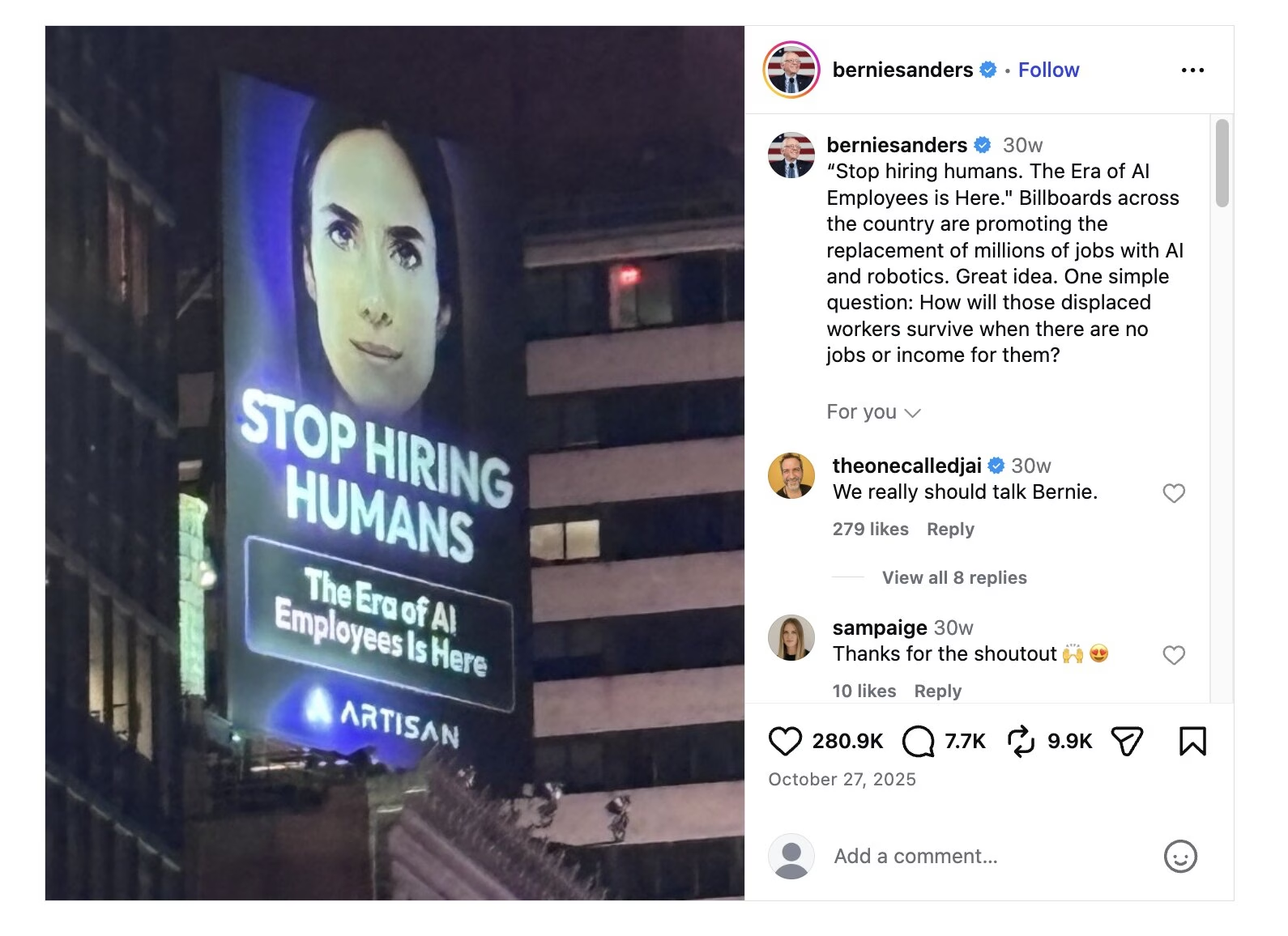
But these ‘visionary’ job cuts often have little to do with the actual implementation of AI technology. Instead, “AI integration” is being used as a scapegoat to mask poor balance sheet management, pandemic-era overhiring, and routine cost-cutting.
In short, it’s a cynical public relations deflection. Telling shareholders and the press, “We are restructuring to pivot towards an AI-first future,” sounds exponentially better than admitting, “We mismanaged our finances and now have to let 10,000 people go.” By AI washing their layoffs, companies attempt to look like visionary pioneers rather than failing managers. It’s a rebranding of corporate failure as technological progress and it is a prime example of why this kind of misdirection is harmful.
Example: Allbirds – from sustainable fashion trailblazer to AI
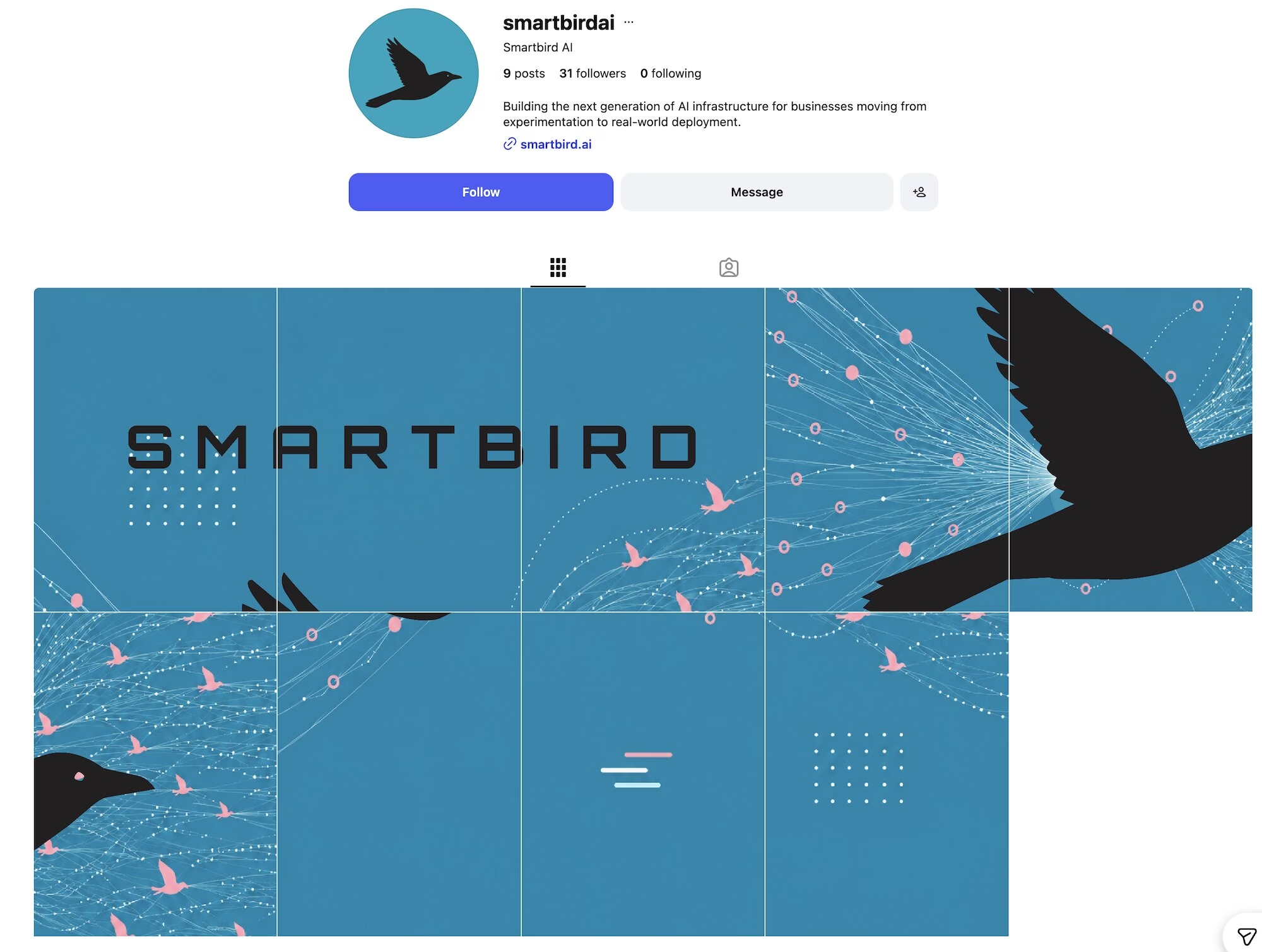
To see just how intoxicating – and bizarre – this trend can be, look no further than the recent saga of Allbirds. Once the doyen of the sustainable footwear movement, the company built its whole brand ethos around being a public benefit corporation committed to eco-friendly materials and ethical manufacturing. At one point they even pioneered the world’s first net zero shoe built without any offsetting. Incredible! However, in April 2026, the trailblazing shoemaker issued the shocking declaration of a sudden “pivot to AI.” That’s not to AI-engineered footwear but away from shoes entirely and into AI compute and GPU cloud services!
Despite the amusingly-scary reinvention – like David Attenborough abandoning his latest documentary to become an investment banker – the market’s instantaneous reaction was revealing: Allbirds’ share price surged an astronomical 600 percent. Riding this wave of speculative hype, the company officially rebranded as “Smartbird” and, tellingly, scrapped its status as a public benefit corporation altogether. It is one of the first textbook cases of AI washing – a company shedding its foundational sustainability commitments to chase a tech-bubble valuation, armed with little more than a buzzy new name and a sudden, questionable affinity for artificial intelligence.
The sad thing is that others may be inspired by the example because – at least in the short term – the move appears to have worked miracles. Prior to the pivot, Allbirds was struggling to stay afloat and is now on the up, all because of AI and going nebulously all-in.
Example: Builder AI: the AI that was actually just old-fashioned humans
AI washing is older than you think. To see how far back the “fake it ’til you make it” culture goes in this space, look no further than the spectacular saga of Builder.ai (originally launched as Engineer.ai). Long before the buzzword vibecoding was coined to describe using natural language to guide an AI to build software, this company was promising the same magic. They marketed a revolutionary platform where you could just describe your dream app in plain English, and their proprietary AI assistant – “Natasha”- would conjure up the code for you. They pitched the tech as a way to make software development as simple as “ordering a pizza.”
Despite the intoxicating bragadoccio of effortless, AI-generated apps, the reality behind the curtain was a little more oldschool. Natasha was, for all intents and purposes, a front. Investigations – starting with a Wall Street Journal exposé in 2019 and culminating in the company’s dramatic bankruptcy in 2025 – revealed that there was very little artificial intelligence actually involved in the process. Instead of cutting-edge neural networks, the company was diverting the development work to hundreds of human software developers based in India. These workers were manually coding the projects, essentially forced to cosplay as bots.
It remains one of the highest-profile cases of AI washing, and a textbook case that attracted investors like a high-tech bug zapper. Builder.ai managed to secure massive investments by substituting actual Large Language Models with a hidden offshore workforce, capitalizing on the hype of an AI-driven future they couldn’t conceivably deliver. The sad thing is that, for years, the illusion worked – proving just how over-eager the tech industry is to fund an AI fantasy, even when the “artificial intelligence” is just a room full of overworked humans.
Example: AI washing is everywhere – it’s even found in fizzy drinks
Back in 2013, when Coca Cola – one of the world’s worst plastic polluters – introduced its ‘Coca Cola Life’ drink – some people cried greenwashing. The new drink was not packaged in the brand’s iconic red but a wholesome shade of green, adorned with messaging about reduced calories. Within adverts, the cans posed in natural settings; relaxing amid wildflowers and so on. This all proposed a healthier, more mindful choice. In fact, the fizzy gunk inside was no healthier or eco-friendlier than classic Coke.
The drink was promptly discontinued but a decade later, in 2023, Coca Cola updated this approach for the age of AI with a limited-edition fizzy beverage named Y3000. And paralleling the previous backlash, the company was accused of AI washing to boost PR. This fancy new beverage claimed to be ‘co created with AI’ but, behind the futuristic name, critics noted there was little evidence for the use of AI and the drink was just a typical soda. Portrayals of the flavour on Reddit were also unflattering, with one user remarking that it tasted like “sadness”.
But the taste isn’t the important thing. The takeaway is that no sector is immune from AI washing. If a carbonated beverage can claim to be co-created with AI, then expect anything imaginable to claim the incorporation of artificial intelligence to dazzle like the future. These claims must be taken with a pinch of salt (or in this case, several whacks of sugar).
This is also a case that reveals the subtle interplay between greenwashing and AI washing – they both come from the same place and one can lead to another. On that…
Where AI Washing meets Greenwashing
You might be wondering why a sustainable marketing agency is so fired up about a tech industry buzzword. Well, that’s because the Venn diagram of AI washing and greenwashing is becoming a circle.
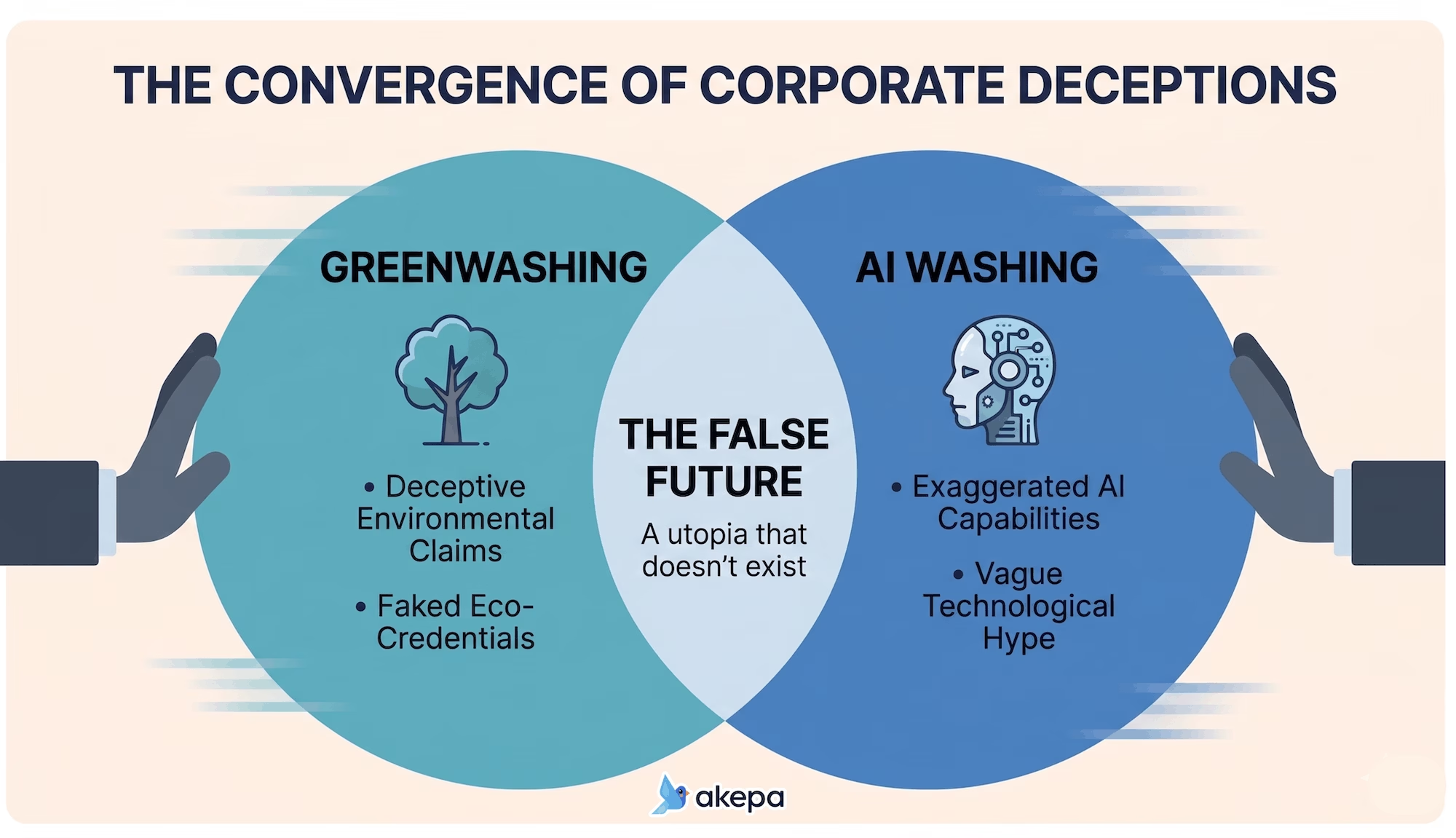
Artificial intelligence requires vast amounts of computing power, which in turn requires colossal data centers, millions of gallons of cooling water, and an immense amount of electricity. When companies AI wash – falsely claiming massive AI integration – they often tangle themselves in sustainability lies as well. To put it plainly, training a single large language model can emit hundreds of thousands of pounds of carbon dioxide. When corporate leaders throw the term “AI” around lightly to sound trendy, they are treating a highly resource-intensive technology as a cheap marketing toy, trivializing the too-real planetary boundaries we are pushing against.
Conversely, companies genuinely using massive AI models often try to greenwash the environmental cost of their servers. We’ve written reams about the environmental impact of generative AI, and it’s a reality that cannot be ignored. If a brand is willing to lie about their technological capabilities to seem innovative, they are almost certainly willing to lie about their carbon footprint to seem responsible. Accountability is a holistic trait; a company lacking transparency in its tech stack is highly unlikely to be transparent about its supply chain or emissions.
How to spot AI washing?
At its core, AI washing is all about misdirection. Putting a compelling performance in one place to try and distract people from the issues that matter. Just like greenwashing, fascinated folk, enthusiastic investors, and dedicated employees are those who fall for it.
So, what should we be looking out for to know if a brand is actually innovating, or just talking a load of new rubbish? Here are some of the red flags:
- Vague ‘techy’ language: Just as greenwashers use legally meaningless words like “earth-friendly” or “farm fresh,” AI washers love terms like “smart,”, “co-created”, “precision engineered,” “AI-powered,” or “algorithmically optimized.” Look out for buzzwords that sound mindblowing at first glance but carry no concrete technical weight.
- Layoff deflection: If a company announces massive workforce reductions under the guise of “AI efficiencies,” be skeptical. Look at their recent earnings reports and general market trajectory. More often than not, the AI narrative is a smokescreen for traditional financial restructuring.
- Danger, danger: When a company itself starts warning people about the dangerous intellect of its own product, that’s a common sign of AI washing. This is an especially popular technique in the realm of chatbots like ChatGPT, Claude, and so on. It’s a calculated exaggeration that plays on human fantasies about AI becoming a potentially malevolent super-intelligence. The goal is to stir-up hype and PR buzz.
- Hacking humblebrags: Further to the above, you may observe AI companies warning that their AI agents have hacked beyond their defined sandboxes or manipulated human testers. While transparency around these threats is important, there is a striking corporate one-upmanship underpinning these confessions. From ChatGPT to Claude to Meta, companies are practically tripping over themselves to admit to escalating, outrageous hacks. Each one suggests a higher threat to humanity, while flexing to impress humans with the growing spontaneous power. These cases may be real but the purpose is duplicitous – for PR manipulation. And ironically, the levity of turning hacking into marketing could increase the risks.
- Irrelevant claims: Making a massive noise about tiny, insignificant, frequently terrible features on an otherwise analog product. For instance, a smart fridge that uses a basic sensor to tell you the door is left open does not need to be branded as an “AI-driven home-cooling ecosystem.” It’s slapping a digital green-sticker on a standard appliance to justify a markup in price.
- Lack of technical transparency: An innovative company will be proud to explain, in reasonably understandable terms, how their technology works. If you check a brand’s website and they cannot explain their data models, what the AI is actually doing, or how it improves the user experience, that is a glaring red flag.
- Rebranding old tech: Products that change their marketing to apply the veneer of artificial intelligence but without actually changing their underlying software. If an automated customer service chatbot from 2018 is suddenly marketed as an “AI conversational agent” in 2026 without a software update, that’s AI washing.
- Absence of governance: Real AI implementation requires responsible guardrails. If a company claims heavy AI usage but has no public-facing AI ethics policy, privacy framework, or data governance structure, they are likely exaggerating their capabilities – or blindly walking into a massive legal liability.
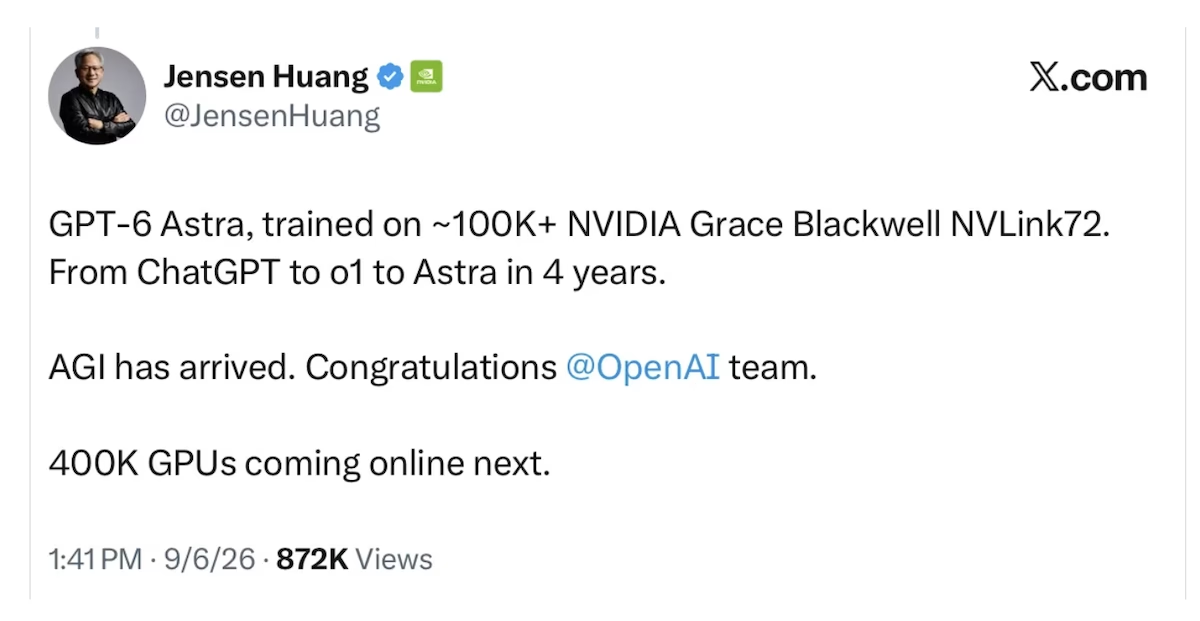
- AGI proclamations: AGI may eventually arrive by consensus but be vigilant when someone says AGI has arrived already – especially if that someone, oddly enough, has a vested interest in hailing the arrival. And besides, there is still no widely accepted definition of AGI (Artificial General Intelligence). Even Sam Altman, while appearing on the Sources podcast, candidly claimed “it’s like an irrelevant marketing term”. Closer to home, you yourself may observe, In the brave new post-AGI-world, that chatbots are still churning out stochastic slop that lacks deeper human originality, rooted in lived experience. You may still be getting told by an “AGI” that your mediocre / rubbish / hopeless ideas are brilliant. Such contradictions are a red flag of AI washing and suggest AGI is still out there somewhere, finding itself.
Some old-fashioned advice: look beyond the buzzwords
Whether we are talking about the environment or AI, or anything else, the antidote to any-kind-of-washing is taking the time to look beyond the gobbledegook.
True innovation, much like true sustainability, doesn’t need to hide behind buzzwords or use vague concepts. It should make sense without lateral thought and there should be specific details. So don’t just take a brand’s word for it when they claim to be saving the planet, and don’t take their word for it when they claim to be pioneering the future of artificial intelligence. Especially if you could get laid-off behind the grandstanding.
On that side, we hope we’ve helped to clarify what AI washing is but there’s still a long way ahead for this trojan horse to trundle along. Stay vigilant and remember that if a corporate claim sounds a little too artificial, then it probably is.




Leave a Reply