


Clicking “Buy Now” is designed to feel like magic. A customer taps their screen and 48 hours later the doorbell rings. It’s frickin’ frictionless. But for purpose-driven brands, there are problems lurking behind the smooth digital illusion, because e-commerce is physical and it’s intense.
Behind the convenience of every online order is the organised chaos of cargo ships, delivery vans, warehouses, fuel consumption, and symptomatic GHG emissions. In the sustainability sector, it’s becoming an oversight to just market your product’s eco-friendly ingredients without accounting for how that product gets into your customers’ hands.
To help, geocoding and spatial APIs help sellers prove what their brands are doing in the real world. They bridge the gap between digital marketing claims and the traversing on the planet. It’s an emerging area of e-commerce that adds veracity to boasts about sustainability.
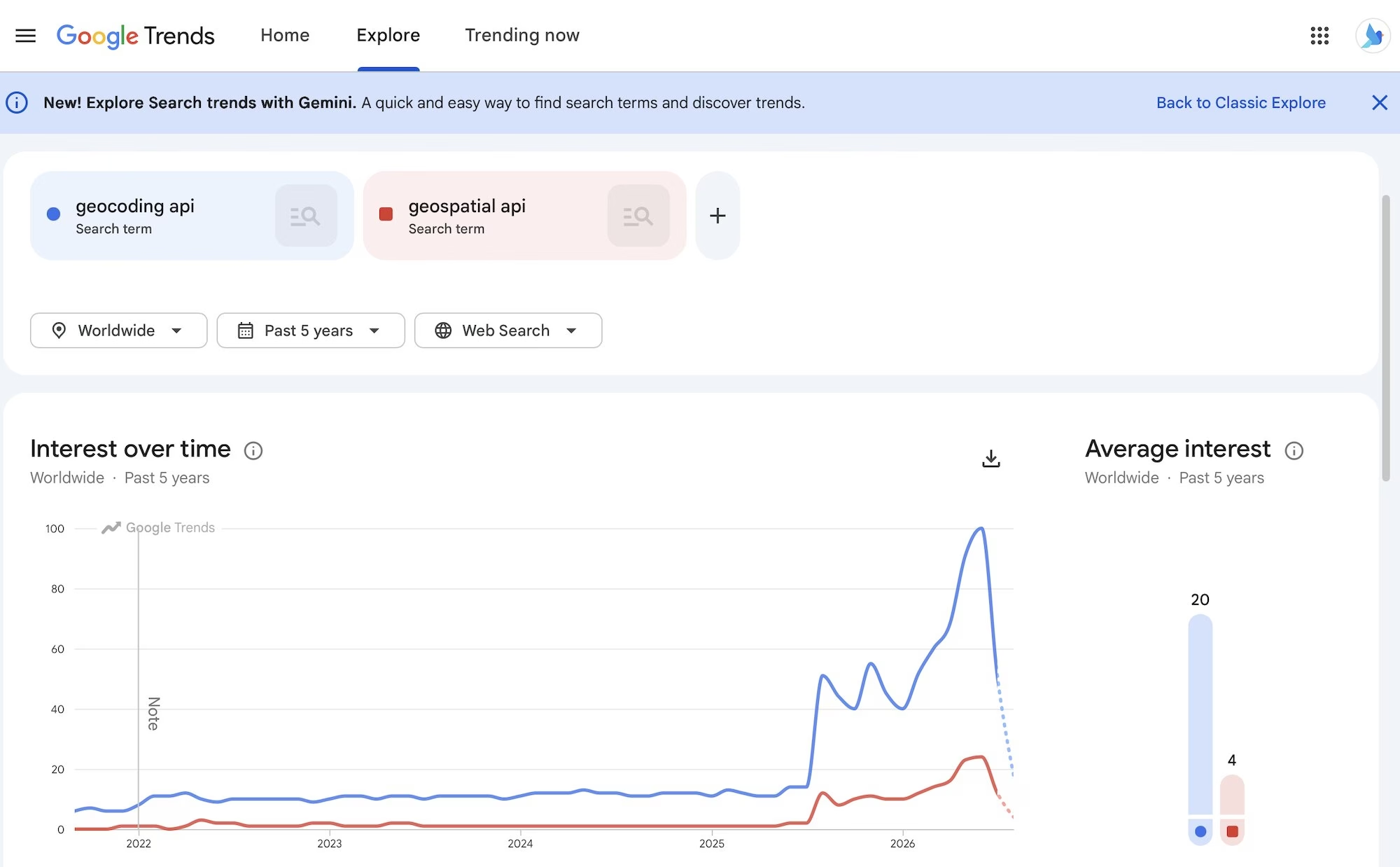
But how do these location-based tools actually work and how can ethical e-commerce brands use them to cut emissions and build trust? Let’s have a peek.
What on earth is a Geocoding API?
Here’s a quick technical primer. An API (Application Programming Interface) is just a digital translator that lets two pieces of software share data.
A Geocoding API is a type of translator that deals with geography. It takes a human-readable address – like “10 Downing Street, London” – and translates it into pinpointed geographic coordinates (latitude and longitude) that can be digitally applied.
But in e-commerce, knowing a location is merely the first step towards understanding the journey. This is where a companion API tool like DistanceMatrix.ai or the Google Maps API take those coordinates and calculate the precise distance travelled and time taken between multiple points, factoring in real-world travel networks.
Instead of a marketer guessing that a package travels “about 500 miles,” an API pings a server and returns the accurate logistical data in milliseconds. For an ethical brand, that data is the foundation of sustainability that runs deep.
When you plug these location APIs into the backend of your e-commerce platform, you’re initiating exceptional ways to lower your footprint and communicate your impact. Here are four of the most effective approaches we see today..
1. Lifting the veil from the supply chain
The most challenging component of sustainability accounting is tracking “Scope 3” emissions – the carbon generated up and down your supply chain before the product reaches your warehouse. In fact, a July 2026 report by The Conference Board found that while 84% of big US companies have climate targets, 62% of those with Scope 3 goals report that their emissions have remained flat or actually risen since 2021 – largely because mapping a global network is so difficult. A t-shirt might be marketed as “Made in Portugal,” but the organic cotton was grown in India, spun in Turkey, and dyed in Spain.
Geocoding APIs allow brands to map this journey with precision. In practice, this works by linking the API to your supply chain’s digital paper trail; as physical materials are scanned at each transit hub – via batch codes, RFID tags, or shipping manifests – the API translates those recorded stops into an exact route, along the way.
Instead of vague waffle about the provenance of your products, you can use location data to build interactive supply chain maps on your product pages. When a customer can visually trace the exact coordinates of where a material was sourced, how far it traveled, and who manufactured it, you fill the vapidity that leads to greenwashing accusations with proper details.
2. Dynamic GHG calculators at checkout
You may have been furnished with the opportunity to “offset the carbon emissions of your delivery” for a small extra fee. Beyond the base issues with cheap offsets, there’s a fundamental flaw with that. It’s usually a generalized guess. It costs the same whether you live two streets away from the warehouse or in the middle of the wilderness, at the other side of the country.
By integrating an API into checkout flows, websites can calculate the exact distance between fulfillment centers and the customer’s shipping address. That exact mileage can then be multiplied by the average emissions of a delivery van, showing the customer the precise carbon footprint of their specific order. It turns a generic offset program into a transaction that’s personalized to the exact human who’s buying, with full transparency. Whatever the issues with offsetting emissions during ecommerce, they should at least be backed-up by an accurate framework.
3. Taming the “last mile” of delivery
In logistics, the “last mile” – the final leg of a product’s journey from a local hub to a front door – is notorious for its inefficiency and carbon intensiveness. Delivery vans idle in traffic, backtrack across neighborhoods, get completely lost, and make half-empty runs.
While this sounds like an operations problem with a calamity human touch, it’s also an opportunity. Brands that manage their own local deliveries (like zero-waste grocery services) can use spatial APIs to solve the problem and – in the future – could incorporate fancy new ways to deliver, like cargo drones. The API calculates the absolute most efficient route between 50 different drops, cutting fuel or energy consumption. As a marketing team, you can then take that API data and proudly announce in a confident tone: “By optimizing our local routes this month, we saved 300 liters of diesel and kept X tonnes of squalid CO2 out of the atmosphere.”
4. Consolidating delivery for greener fulfillment
Sometimes the most sustainable choice is to not ship to a front door, at all. Consolidating twenty orders into one drop-off location can be more eco-friendly than a van making twenty clunky residential stops, zig-zagging all over the place while losing reception to use Google Maps on a mobile phone.
Using geocoding APIs, your checkout page can read the customer’s location and instantly surface the nearest Click-and-Collect points, eco-hubs, or automated lockers. By displaying something like, “Pick up your order at a secure locker just 0.4 miles from your current location and save 1.2kg of filthy shipping emissions,” you give folk that are mindful about their footprint, options. Technology can be used to engender greener outcomes, without relying on guilt.
The key benefits: why bother with location data?
Integrating these tools requires a bit of technical literacy but for our clients at Akepa, the payoff goes beyond good feeling. When you connect spatial APIs to your marketing and operations, there are some decent bottom-line benefits:
- Replacing insipid buzzwords: In a market that’s now flooded with fluffy eco-friendly buzzwords, buyers are frankly bored. When you back up your claims with exact geographical coordinates, real-time mileage, and calculated emissions, you replace insipid marketing fluff with sizzling math – and that’s attention grabbing.
- Boosting conversion rates: When customers see an interactive supply chain map or a dynamically calculated carbon offset at checkout, it acts as a trust signal. That trust translates into higher checkout completion rates and stronger brand loyalty.
- Operational cost savings: This is the advantage of sustainable logistics: green is lean. If an API helps your fulfillment partners cut delivery mileage by 15%, you are saving money on fuel and labor, alongside GHG emissions.
- Future-proofing for compliance: Regulatory bodies across Europe and the US are tightening the rules on corporate environmental reporting. By building API-driven tracking into your e-commerce infrastructure now, you are automatically generating the geographical data you will need for compliance reports tomorrow.
What’s the point of sustainability if it’s shallow?
Getting down to the wood of emissions involves not just looking at a product’s composition but the product’s journey. Understandably, more sustainable brands are attempting to trace the adventures that their products have been on. If they don’t then they can’t become less wasteful and they also can’t tell convincing stories.
Yet, you’ll notice that no brands – even the best – are nailing this. This is because it’s still relatively early days for location data, APIs and so on. It’s also early days for new forms of delivery that will rely on location data. But expect to see more of a bridge between the products you buy or sell, and their imprint on the real world’s land, oceans, rivers, and air, coming soon.
Which is positive, because just talking about what a product is made of, is nowhere near enough. It’s not so different to considering a human’s nature just by their appearance and the chair they’re sitting on now. Or something.
Well, we hope we’ve elucidated an emerging area of e-commerce – and if you’re interested in becoming a pioneer, let Akepa know and we can elevate your website to an exceptional point.




Leave a Reply