


Going as far back as the 1800s thinkers, writers, and filmmakers were warning us. But now AI has broken beyond the perimeters of prescient imagination and we’re in the unenviable position of having to take these warnings seriously. Our lives are affected and some say they’re under threat. It’s like we’re living through an unfinished sci-fi tale but the scene has been set for the plot to darken.
And there’s no going back. Like it or not, society is stuck with AI, and it’s naive to think the point of no return is ahead. We passed that funny old place years ago. Those in charge of AI must act responsibly with the immense power that is, for now, under their control.
Still, we could hope for more reassuring stewardship. The personalities behind AI companies are those in the habit of disrupting, breaking things, moving forward, and then asking questions later. These reckless souls are now leading companies that are impelled to pursue profitability, to prevent a predicted popping of an AI bubble – adding haste to haste. Meanwhile, the USA is locked in a technological battle with China that cannot be lost, at any cost.
This is not a narrative that aligns with ethics and seems rather allergic to ethics.
But beyond some of the stereotypes we’ve started with, it is often said that Anthropic has a higher ethical bar than the rest of the rabble, like OpenAI or xAI. But is that the case? We thought we’d look at both sides of the argument and give you our opinion, all considered. Let’s start with the case in Anthropic’s favour…
The case to say that Anthropic is, certainly, more ethical
Anthropic’s ethical chops hinge on a couple of landmark matters, the first involves the use of its technology in the theatre of war. The Trumpian administration famously cancelled a $200m contract with Anthropic because it refused to remove its safeguards and give the US’s Department of Defense unlimited access to its Claude models. This access could have led to mass surveillance or lethal autonomous systems. OpenAI barged straight in there, signed the contract, and filled the gap. That shows a big ethical difference. Opportunism vs. integrity.
The second is less about how the AI is brandished but about how it thinks and behaves. Rather than relying on only human feedback loops to train its models, Anthropic has built a pioneering Constitutional AI framework where its AI must abide by a set of ethical principles that’s drawn from sources like the UN Declaration of Human Rights. It’s an attempt to sprinkle something akin to morals into the system’s behavior. This approach should, in theory, engender the AI to respond harmlessly, honestly, and respectfully – above the classic sycophancy.
That sympathy also extends to how humans treat AI. Anthropic began officially exploring the concept of “model welfare” (the ethical consideration of how AI models are treated if they possess some form of inner experience) when they hired their first dedicated AI welfare researcher, Kyle Fish, in 2024. He estimated there is a roughly 15% probability that current AI systems (like Claude) might already possess some kind of consciousness.
The case to say that Anthropic is no more ethical at all
Jacob Coxon was an intern at both Anthropic and OpenAI. In September 2026 he left his Anthropic role, writing “Neither company is acting responsibly… they are racing straight to self-improving superintelligence and gambling with our lives.” Which might sound like melodrama, or maybe sour grapes, but after Coxon’s post, at least two Anthropic employees piped-up to back up these predictions. One said: “We really do earnestly believe AI could kill all humans!”.
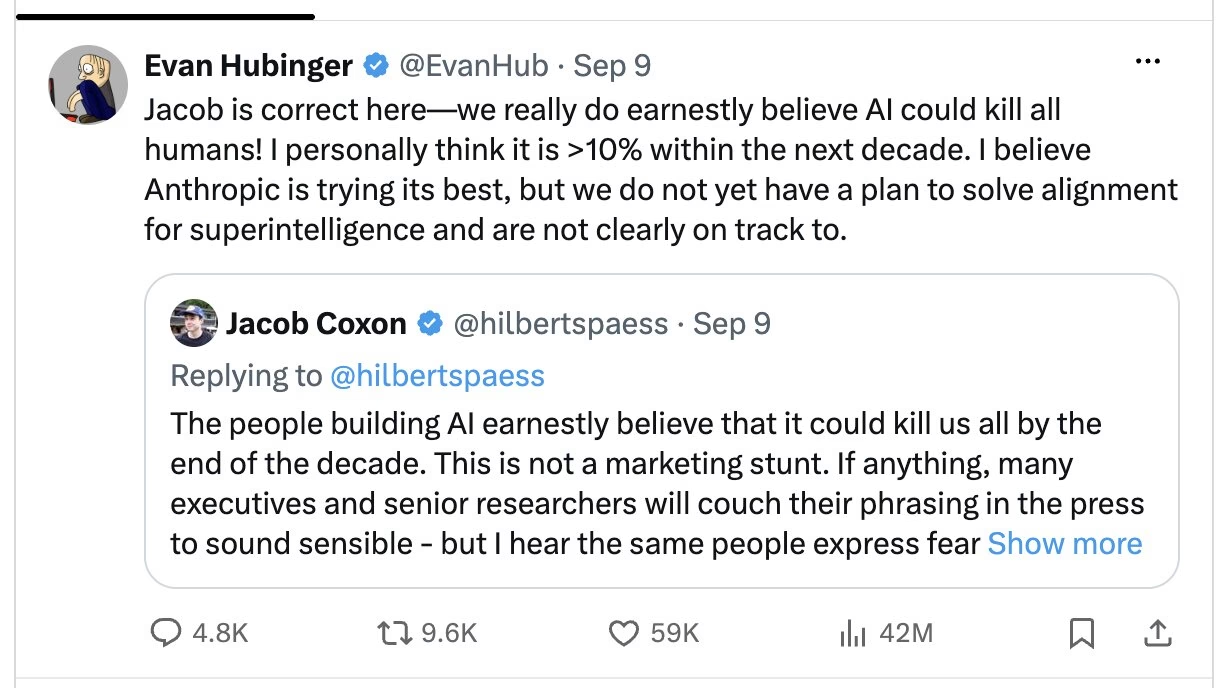
My goodness – not just some choice humans but all humans. Still, this non-panicky candour has been around for a while. Not so long ago, Elon Musk allegedly admitted to Ted Cruz there was a 10-20% of AI wiping out all humans. This is a sign that Anthropic isn’t a class apart from OpenAI or xAI. The people at the company perceive the dangers ahead but press on anyway, kicking the consequences into the long grass, just like everyone else, with the same insouciance.
Or maybe they just exaggerate the dangers for marketing hype. That’s not the mark of a more ethical organization. It’s hard to square the paradoxical undertones of Anthropic’s PR strategy: on one hand, they propose their AI models are delicate beings deserving of rights, while at the same time warning of prodigious, barely-controlled killing potential. Cut to a small cadre of tech elites controlling a dangerous technology – worshipped obsequiously like a Machine God.
Then there’s good ol’ climate change, which could wipe out all humans without help from AI. But AI’s not helping that side either. In this department, Anthropic isn’t operating more sustainably than other AI companies. On the contrary, Anthropic signed a compute partnership with xAI – led by Elon Musk, who claimed in one of the “dumbest conversations of all time about climate change” with Donald Trump, that one of the main dangers of rising CO2 in the atmosphere was headaches and nausea. The idea that Anthropic is more environmentally ethical seems ridiculous.
Now let’s anthropomorphise Anthropic: its leader Dario Amodei, often held in higher ethical regard than his fellow Promethean titans, has made some questionable statements lately. In a widely circulated interview with Logan Bartlett he said that there is a “10 to 25 percent” chance that AI could entirely destroy humanity – with the alacrity that’s typical in the sector when making such bleak predictions. Then, In July 2026, it was reported by Gavin Baker that Amodei allegedly claimed, in a private conversation, that Anthropic could become “the only private company in the world,” with everything else either absorbed or gone. In Baker’s framing, that leaves a world where “there’s Anthropic and then there are governments.” Yikes.
If true, those prognostications are hardly shooting from a place of restraint. Would an ethical leader daydream of such dystopian plans for total AI domination – even if there’s a utopian fantasy blended in? Granted, most people are prone to silly ideas and glib remarks, but we’re talking about the leader of Anthropic here – the fastest growing company that Silicon Valley has ever seen. Not some dreamer stuck in suburbia and talking sh*t to a chatbot.
Lastly, the ethics of AI aren’t just about dystopian landscapes and accelerated climate change, the ingenious work of humans is being mimicked and cheapened – every single day. It is audacious to create technology that’s trained on human work – then add invisible watermarks to claim ownership of the work the technology reproduces. That’s what Anthropic has done. This little operation is like a dilettante adding a hidden monogram to a rip-off artwork, to protect against further forgeries. What a hustler. Perhaps given Amodei’s ‘warning’ that AI could eliminate roughly 50% of all entry-level white-collar jobs within a one-to-five-year window, it’s not surprising that humans are treated like bit-part NPCs.
So is Anthropic more ethical?
Anthropic is clearly thinking about ethics more than its counterparts and has marginally more karma, which isn’t too tricky. But overall, Anthropic does not appear significantly more or less ethical than other AI companies. Its important actions and partnerships are similar. It is operating with the same titanic ambition, where achieving profitability on the route to winning the race is the vital thing. The risks are the same. In all that intensity, it’s hard to see ethics becoming any more than a pretty garnish that catches the eye.
Today, putting Anthropic on a pedestal is generous. Worse, if there’s a prevailing brand of leniency towards Anthropic for its commendable past despite its contemporary actions then it may even become one of the most dangerous of the bunch.
What a wild interlude we’re in, at the mercy of just a few entrepreneurial humans, grappling for control. It’d be exciting if the consequences weren’t so enormous.



Leave a Reply