


A B Corp certification is displayed by businesses to communicate to people that they’re trying to reduce harm across the environment, society, and business. It’s a public commitment to “meet the highest standards of verified social and environmental performance, public transparency, and legal accountability to balance profit and purpose”.
This certification has gained a lot of momentum over the past decade, with the number of B Corps growing considerably – including global brands like Patagonia, VEJA, Rituals, and Ben & Jerry’s.
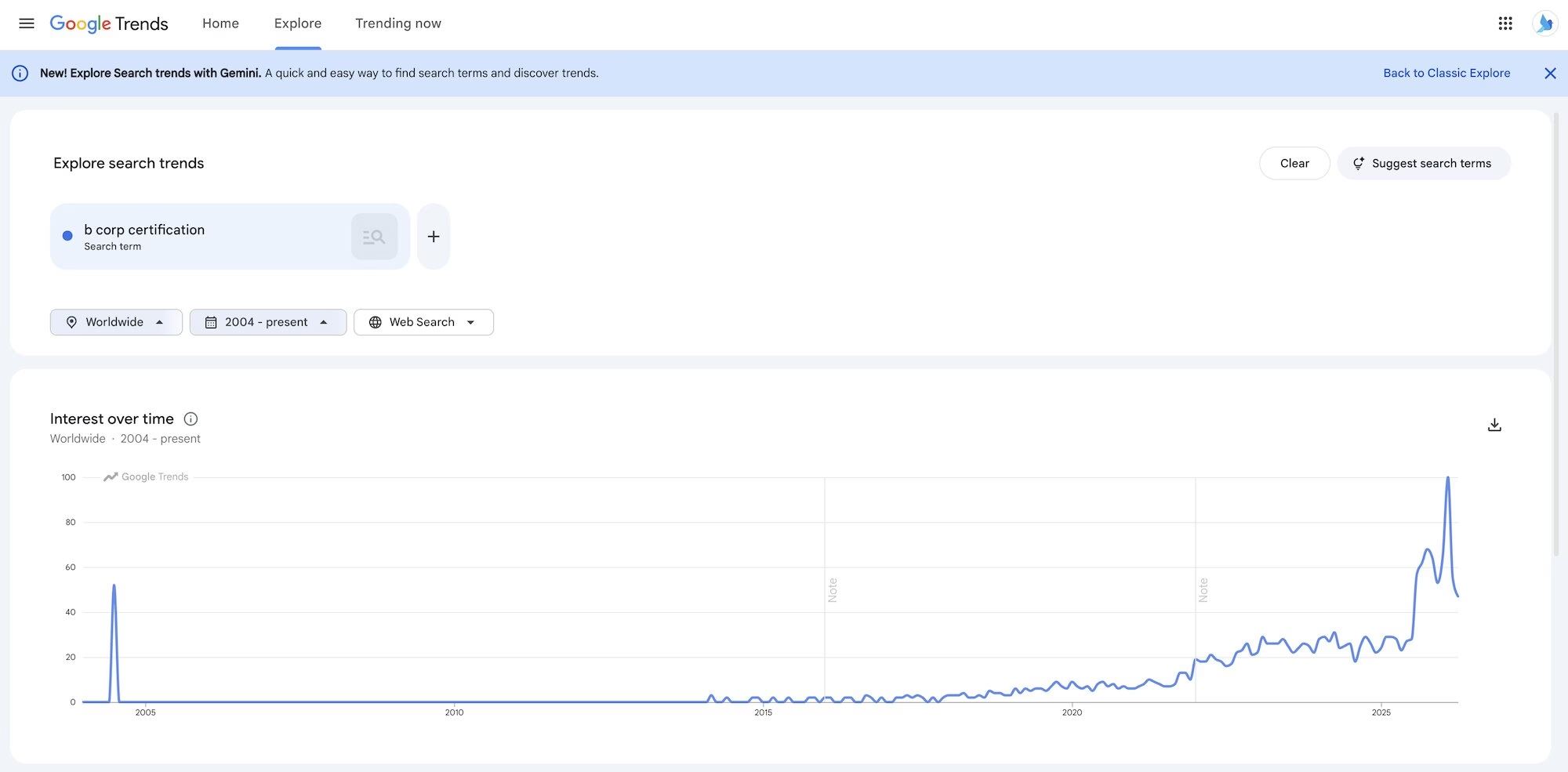
Aside from caring for the environment and upholding ethical standards, there are other reasons why a company might choose to get B Corp certified, such as to stand out from competitors and show buyers that they care. This might only sometimes be an accurate reflection of real sustainability though, and there are criticisms of the B Corp certification. Some feel the impact of B Corps is hard to assess. Others say their standards are not legally enforceable and that any regulation changes remain secretive.
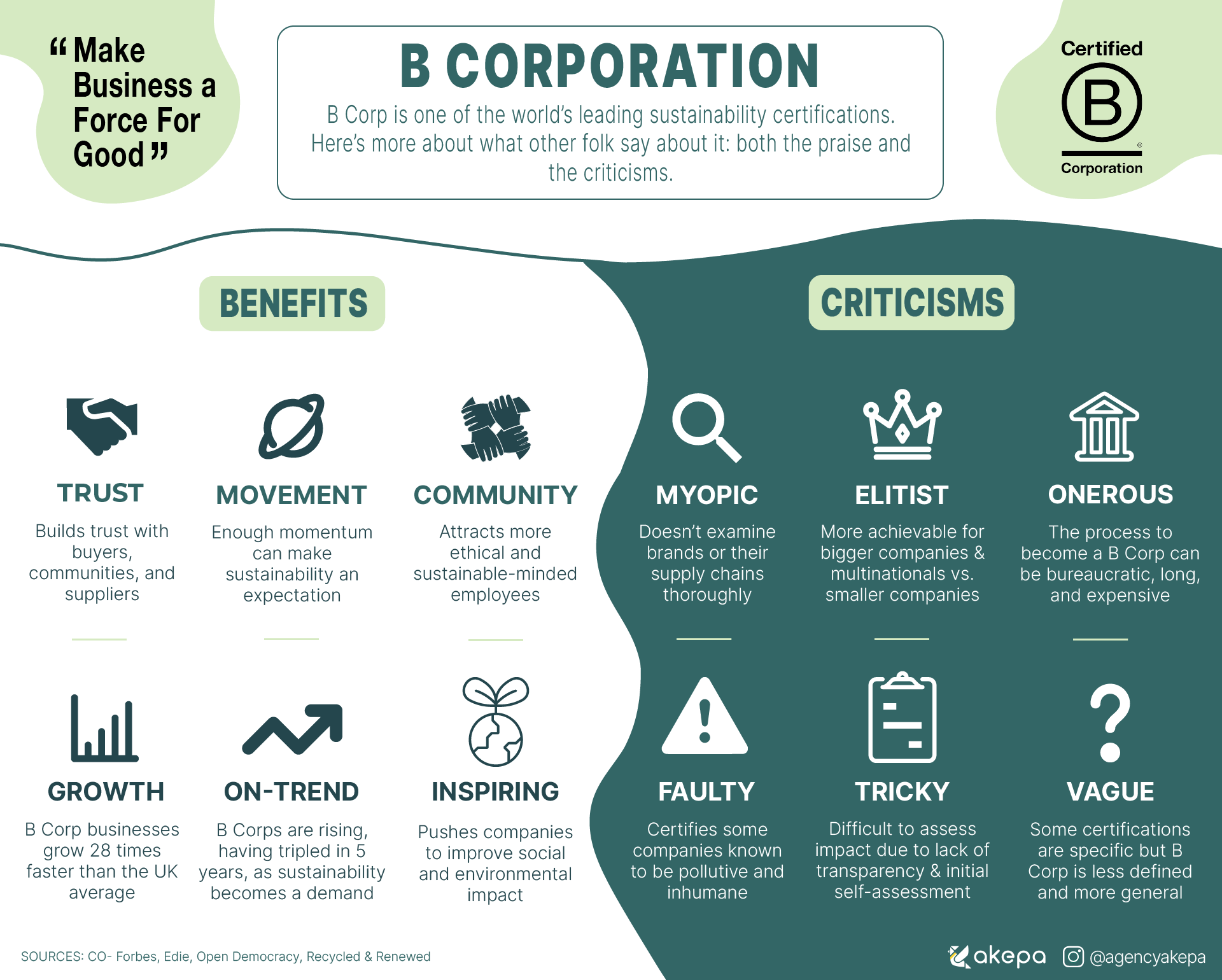
Look, it’s a top certification; no doubt about it. But understandably, you might not want to become a B Corp because you’re just not convinced, or because you’re in the start-up phase of your company and you don’t meet the one-year requirement yet. The costs could be an issue, as it’s not cheap. Maybe you just want to do things differently, you maverick!
Of course, that doesn’t mean you’re not a sustainable or ethical company – and if you are, then there are definitely other means of getting that message across.
The following list is not exhaustive and the market’s evolving all the time. But here’s some inspiration for the near future:
1. Other certifications & partners
B Corp is about balancing purpose and profit, you could say it’s about ethics, and other certifications address sustainable practices from different angles. There is no single certification that covers ‘sustainability’ entirely and there’s no direct equivalent of B Corp. Nevertheless, there’s an assortment of certifications a company can choose to distinguish themselves, each offering their own focus. Here are a few of the main examples and the specific aspects they cover:
- 1% for the Planet was founded by the founder of Patagonia and it connects leading environmental organisations with companies who pledge to give 1% of their total revenue to the cause. We’ve just joined this initiative ourselves.
- Cradle to Cradle Certified: This one’s for companies that sell physical, non-edible products. It verifies a circular approach to business (aka ‘the future’) by assessing the safety, circularity, and responsibility of products across 5 categories: material health, product circularity, clean air & climate protection, water & soil stewardship, and social fairness.
- EU Ecolabel certifies all kinds of goods and services, this certification promotes Europe’s transition to a circular economy, evaluating product life cycles from start to finish following a stringent set of criteria that are certified by independent third-party bodies.
- ISO 14001, is an internationally agreed standard that sets out the requirements for an environmental management system. It helps organizations improve their environmental performance through more efficient use of resources and reduction of waste.
- GoodWell, originally founded to help correct the gender pay gap, this one aims to boost employee happiness by evaluating employee feedback across 11 metrics. This certification touches every area of a company’s supply chain to make sure that all employees are treated justly. Companies receive a score ranging from -100 to +100. The GoodWell Certified Badge is awarded to companies with scores over 0 – those who’ve demonstrated their commitment to employee listening and wellbeing.
- Climate-focused: While B Corp is a generalist certification, there are climate-focused accreditations emerging. The Climate Label is one of those with the mission of getting brands to measure, offset, and reduce their emissions. Needless to say, any certification involving offsetting of emissions must be combined with an approach of reducing them.
- Plastic offsetting: You’ve surely heard of carbon offsetting, right? But plastic is a massive environmental issue, too. Some companies, like rePurpose can help other companies to remove plastic and balance what they release into the environment.
- Rewilding & reforestation: You can help mitigate climate change and the erosion of ecosystems by partnering with focused organisations. Two good examples are Mossy Earth and Eden. Bear in mind that rewilding and reforestation are different – with distinct pros and cons.
With those in mind, an alternative to the B Corp certification is to select a pic ‘n’ mix portfolio of the finest certifications available. In this way, you can also support specific causes that are most important to you.
However, bear in mind that in the same way a B Corp certification receives criticism, other certifications do, too. There is no perfect certification, just like there are no perfect companies. And at the end of the day, certifications mean nothing if your business model is unsustainable at its roots.
So while an alternative to being a B Corp is to look at other certifications, being ‘sustainable’ is also about building a fundamentally good company without that kind of validation. Let’s look at a few of the alternative certifications approaches that are just as good as being a B Corp (even though you don’t get a badge). But remember to talk about these roots if you’re laying them down.
2. Become a benefit corporation
‘B Corp’ and ‘benefit corporation’ are often confused with each other, but they are distinct and a company can be both. While B Corp can be any legal for-profit entity, a benefit corporation is a type of corporate entity that places social and environmental values on the same level as profit. This type of legal structure is for businesses that have a dual purpose of making profit and promoting a positive impact on all stakeholders. Some examples of benefit corporations are Patagonia and Kickstarter.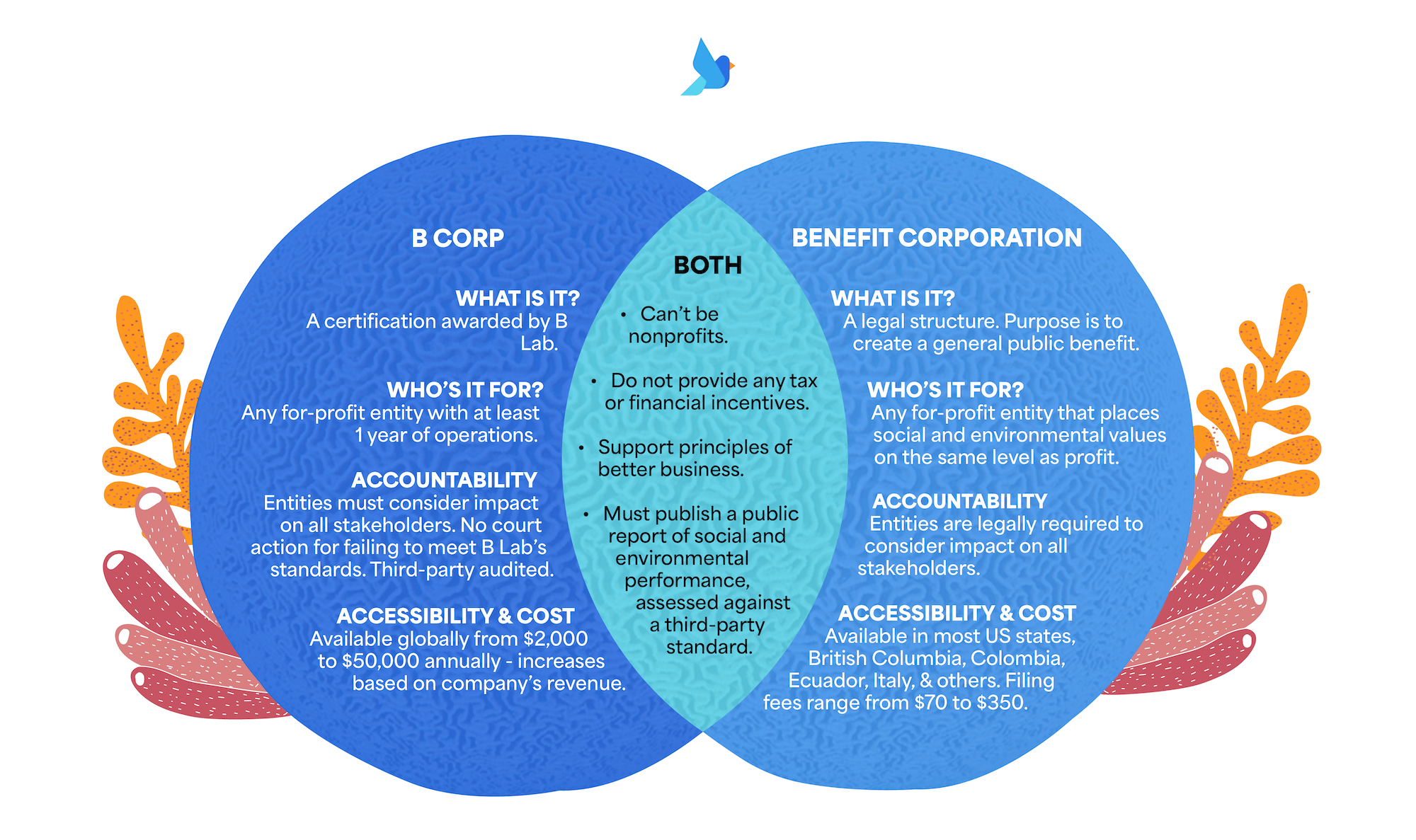
3. Remote work – for proven impact
As far as we know, there are no remote working certifications. It’s not really an area that suits a certification. Nevertheless, a move to remote work can be one of the most impactful changes a company can make.
The reasons are simple. Not having an office or commuting can save significant amounts of waste and studies have shown it can cut workers’ emissions by more than half. And remember: sustainability is about people too, so giving folk more time and flexibility – and not piling everyone into an office every day – can be kinder on human factors like mental health.
Can it work, though? Yes! Just a few years ago remote work was frowned upon – it still is to some extent. But now, it’s perfectly feasible to work remotely or in a hybrid way. Akepa does it with workers in disparate parts of the world and it really isn’t an issue. Humans are more than able to get work done when they’re not at arm’s length.
4. Offer a window into your sustainable business
Many companies choose to not be transparent simply because it’s not required. How often do you see brands unsolicitedly displaying their supply chain and what their workers are up to? If you’re a brand and you want to be different, and you want to show people that you have a purpose over profit as the B Corp certification suggests, then let people see your brand’s ins and outs. After all, 73% of consumers are willing to pay more for products that guarantee total transparency.
5. Smooth out the corporate corners
We’ve entered a new era of business. Companies are now almost obliged to sustainably transform their business models. Yes, that’s what the planet needs but it’s also what people want. With that in mind, if your company is still a part of the so-called linear economy, assess if you can make that linearity more circular. Get rid of the ‘take-make-waste’ mindset!
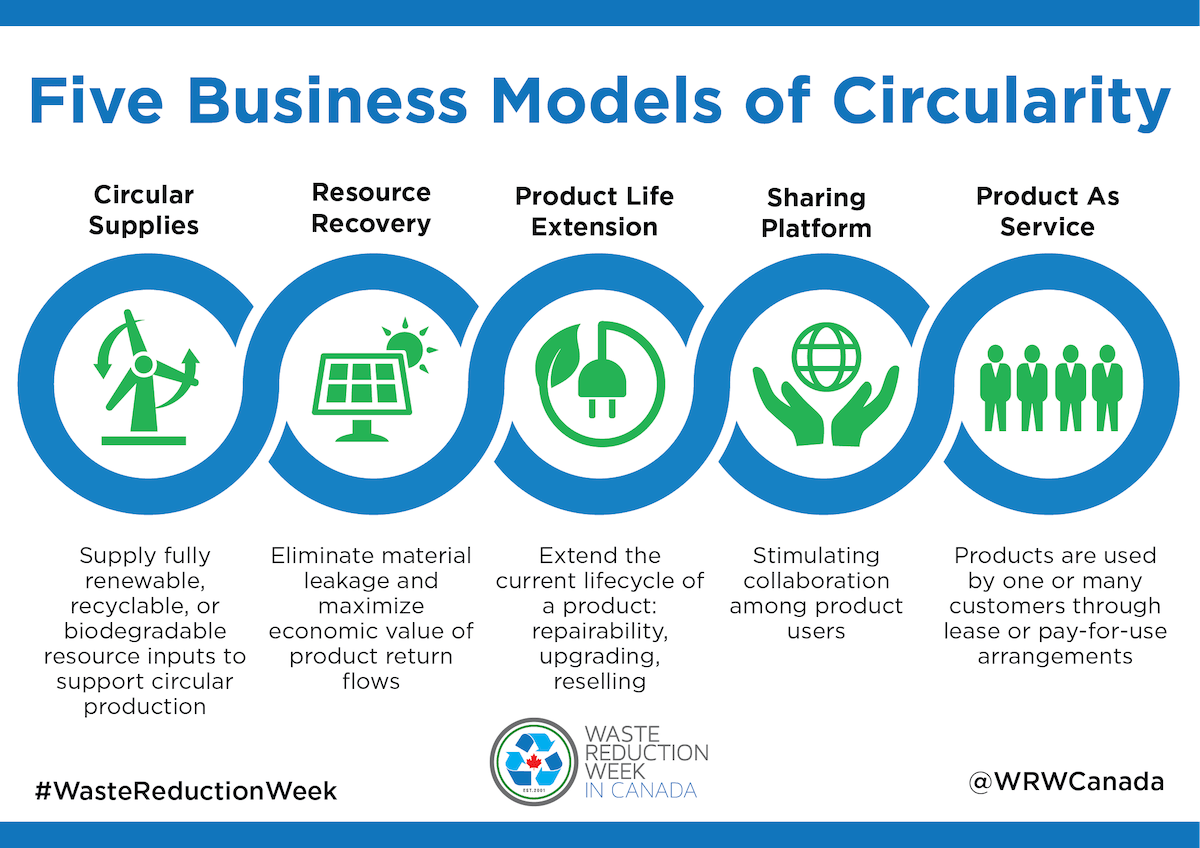
How does that work in practice? Well, an excellent example of a circular company is MUD Jeans. They pioneered a “Lease A Jeans” model where customers can rent their denim rather than own it outright. Once the jeans are worn out, they are returned, shredded, and recycled into brand-new jeans, completely closing the production loop and saving vast amounts of water and waste.
And yes, It’s a little bit of a trickier concept if you’re a services company but still worth a bit of mulling over. There are always ways.
6. Who are you working with?
One of the criticisms of B Corp Status, which we’ve covered in a bit more detail in this post, is that the certification may not scrutinize a brand’s customers and collaborators. The sustainability of clients, partners, suppliers, supply chain, and so on.
Staying within our milieu for this example, a marketing agency may be B Corp certified. All great on the surface, but what if that marketing agency is working to help clients who’re not in the least bit sustainable, grow and succeed? Say, with companies that are appallingly pollutive? For example, a fast fashion company or a drinks company that leaves a load of plastic lying around on beaches in faraway places. Frustratingly, some B Corp certified marketing agencies are known to work with fossil fuel clients.
We’d argue that’s against the spirt of any reliable certification – and who’s to say that B Corp is inspecting any agency’s clients on an ongoing basis? So, an alternative to being B Corp certified – or to any certification really – is to remember your mission and choose your business partners carefully. This keeping of good company might not be covered by any shiny certification but it’s as important as anything.
Here at Akepa, we’re always looking for ways to be a better breed of company.
We’re looking beyond becoming a B Corp, too. So far, our approach is a potpourri of the certifications and ways that we’ve mentioned in the post:
- A member of 1% for The Planet
- Specializing in work with other ‘sustainable’ businesses
- Saying no to industries like fossil fuels and fast fashion
- Reducing emissions with a 100% remote working model
- Getting involved in reforestation and rewilding projects within the UK & EU – via Mossy Earth.




Leave a Reply