


You’ve surely heard someone pontificate about AI Slop but what about the AI Blob?
It’s a shimmering narrative of bulbous generalities that trundles around and swallows everything vaguely AI in its wake – in turn, increasing its size.
“AI could help to tackle climate change”. ☺️
Aha! The Blob is approaching…
Consider that statement. Could AI help to tackle climate change? There is no convincing evidence that GenAI can help the planet or its people. Quite the opposite. The impacts are scary when you look at the details and to become more optimistic you need to start dreaming-up utopian farces.
There is an argument that AGI – another type swallowed up by the blob – could help to discover new technologies, as well as ‘all physics’ but that’s deeply speculative. Any of that grandstanding must be taken with a grain of salt because it’s designed to create hype and investment. Or it’s mechanophilia and, like any other fetish, extremely exaggerated by arousal.
Narrow AI on the other hand, shows plenty of promise – and has for years. Brands like Greyparrot, Rainforest Alliance and unspun™ – are doing wonderful work in areas like conservation and recycling. We’ve covered those brands and some others in our blog post on brands using AI for good. None of them are creating sloppy videos of Princess Di doing parkour or anything like that.
This conflation of different species of AI into an amorphous blob of ‘AI’ is becoming a problem. It makes considering the impact of AI tricky to understand. At its worst, it’s a confusion that could be used for obfuscation by the technological bros.
We’re not being opinionated anti-AI luddites – others think the same. A recent, painstaking report from Ketan Joshi, looked at the bold claim AI could help reduce GHG emissions by 5-10% by 2030, in detail, tracing its history. His investigations uncovered the source of the stat was a 2021 report from the Boston Consulting Group based on loose experience with their clients before the AI boom even got going. Veracity; none.
The report also found that the only evidence for AI having a positive impact on climate change related to older machine learning models, which you could call narrow AI. Not the generative AI boom that’s resulting in a data-centre explosion and severe environmental side-effects.
In short – calling everything AI in the climate context is misleading because it’s too sweeping – and that can be taken advantage of to misdirect. A bit like greenwashing.
This misdirection isn’t just a devious bit of PR spin; it distracts from the real footprint of the current generative boom. While the Blob rumbles around promising to magically optimize the power grid, the physical infrastructure powering it is furtively guzzling millions of gallons of fresh water for server cooling and sapping fossil fuel plants. It’s a classic bait-and-switch: selling the utopian dream of a self-healing planet to obscure the billowing smog over there.
For organizations and individuals trying to make better choices, early detection of the Blob is essential. If we can’t separate the highly efficient algorithms tracking illegal logging from the energy-hungry titans generating six-fingered digital art, we risk focusing on the wrong solutions.
So, when considering if AI can ever be ethical, or could be helpful, or having any kind of debate about AI – it’s helpful to distill the blob into its separate types, such as:
- Narrow AI
- Predictive AI
- Generative AI
- AGI (Artificial General Intelligence)
- Superintelligence
- Agentic AI
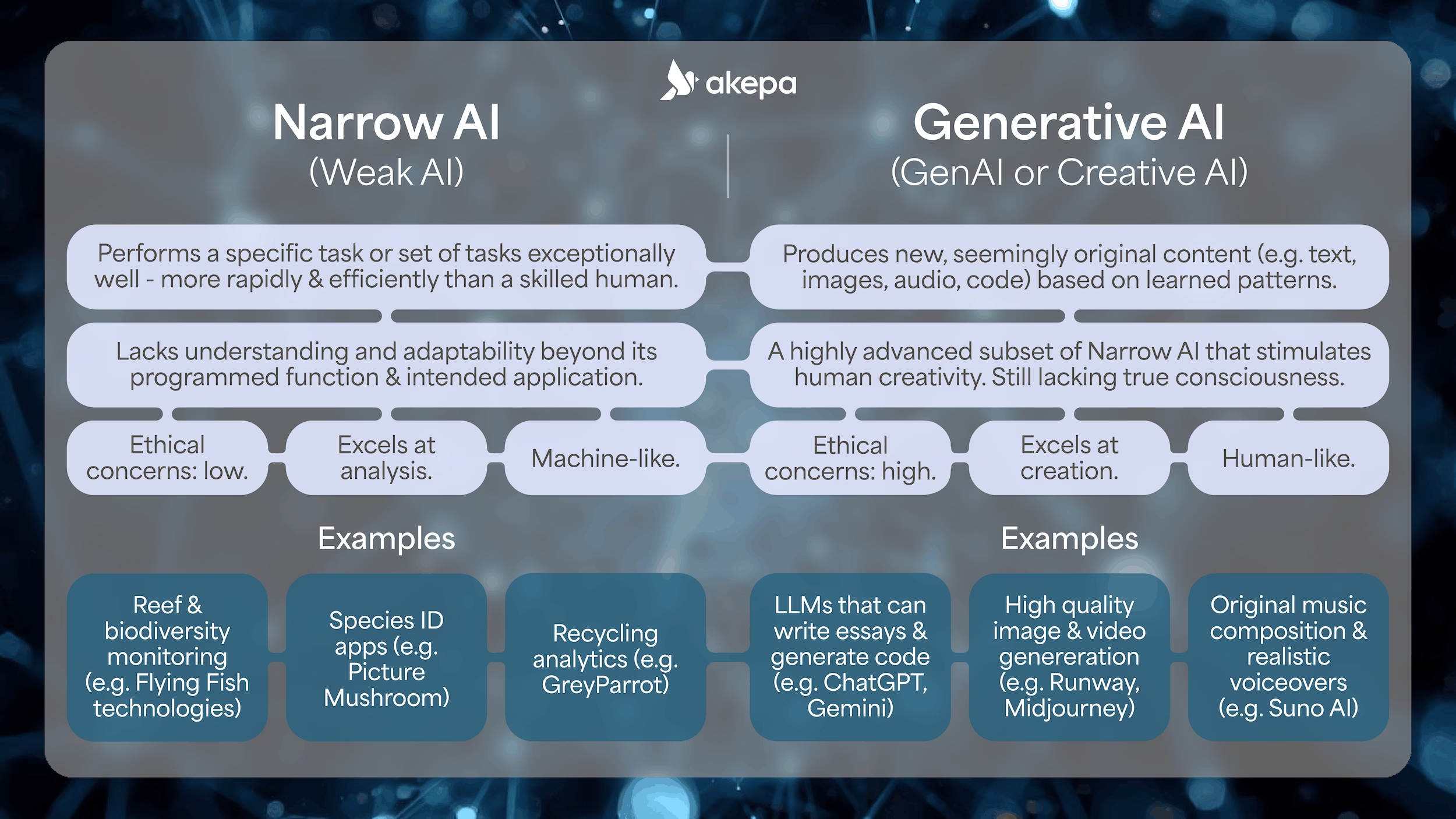
And so on. The classification isn’t straightforward because there’s overlap. GenAI is often viewed as a subset of Narrow AI but we’re not aiming at perfection – just a lexicon that leads to a dialectic that’s clearer than the AI blob’s hedge-fund waffle. Here it comes!
Quick. Hurry. Before we go, here’s a quick table we made about the differences between GenAI and Narrow AI, to help, the next time you hear that ‘AI’ is going to help solve coral bleaching, rescue some endangered Indonesian parrots, or something like that.




Leave a Reply