


There have always been ethical businesses but there haven’t always been B Corps. Today it’s different: if you start an ethical business then it’s almost certain you will consider B Corp certification, at some stage. This is because, like it or not, B Corp has become synonymous with corporate ethics and if you don’t carry the certification it can feel like the vital evidence to prove you are as ethical as you claim, is missing. In the eyes of your selective customers, you’re not as nice as you say you are. You’re not a B Corp.
It has been trending this way for the past decade or so. The number of B Corps has risen steadily since around 2015 and, at the time of this article, stands at over 11,000 in 104 of the world’s 195 countries. It might surprise you to know that London has the highest concentration of B Corps in the world. You may see more B Corps in some flashier sectors, like fashion, but B Corps are pervasive and extend across more than 160 distinct industries.
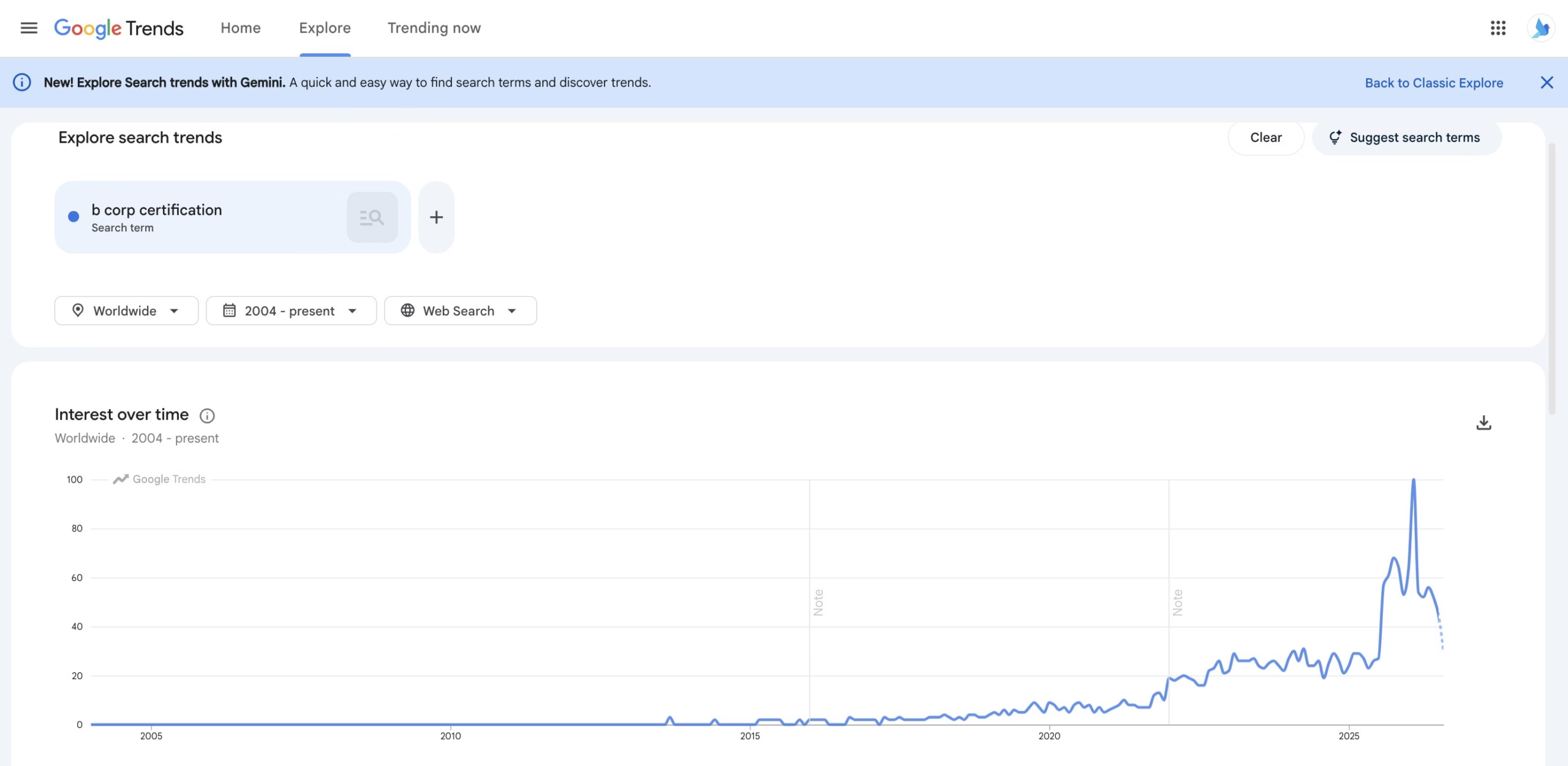
Recently, though, the certification has started to lose some of its luster and is facing accusations that it’s a performative badge used for greenwashing. We’re going to look into the certification and give you our view on whether B Corp is greenwashing or not. Along the way, we’ll look at some facts and stats from B Lab UK’s official 2025 impact data release.
The case to say B Corp is certainly not greenwashing
To start with, the barrier to entry is notoriously high. Earning a B Corp badge isn’t a matter of paying a fee and ticking a few boxes on a self-assessment survey. The B Impact Assessment (BIA) is a rigorous, onerous, third-party verified audit that thoroughly investigates a company’s governance, workers, community, environment, and customers; its soul. More importantly, to become certified, a business must legally amend its corporate articles of association to mandate that it considers the impact of its decisions on all stakeholders – not just its shareholders. That’s a legal commitment to put purpose on par with profit, which is a towering barrier for any company attempting an insincere PR stunt.
Objectively, the data suggests that this stakeholder-led approach creates stronger, more resilient businesses. Recent statistics from B Lab UK – which represents the largest B Corp community in the world – reveal that purpose-driven firms are commercially outperforming ordinary businesses. Between 2023 and 2024, small and medium-sized UK B Corps saw a 23.2% increase in turnover, comfortably beating the national average of 16.8%. Ethical business, it turns out, can make money.
They also perform exceptionally well when it comes to attracting and retaining talent. In that same timeframe, UK B Corps saw a 9.6% increase in employee headcount, while the national average shrank by 0.5%. This makes sense when you look at the human side: B Corps are 25% more likely to pay all employees a true family living wage. For modern workers, who are increasingly factoring corporate ethics into their career moves, the B Corp logo signals a company that actually cares about their welfare.
Then there’s the all-important environmental and community impact. While other businesses faking green credentials might rely on cheap carbon offsets or make distant pledges at 2050 or something, B Corps are restructuring how they operate. According to B Lab’s data, certified businesses are 104% more likely to run their operations entirely on renewable energy compared to standard companies. They are also 114% more likely to have community representatives sitting on their board of directors, helping local voices project themselves less squeakily in the vast roaring of corporate interests.
When you look at these metrics, the argument that the entire system is a greenwashing facade starts to shake, and lose stability. For the majority of the 11,000+ B Corps globally, the certification is a hard-won reflection of systemic change. The stats suggest B Corps are better businesses.
The case to say B Corp is, perhaps, greenwashing
The case that B Corp has become a greenwashing badge hinges on certified firms that don’t appear to be ethical organizations, or anywhere near that mark.
Yes, there are plenty of amazing B Corps. But there are also extremely dubious B Corps. You have to wonder how on earth some of them, like Nespresso, are certified. For those not familiar with the George Clooney-endorsed coffee brand, it makes coffee capsules in single-use aluminium pods and is wholly owned by Nestlé – consistently ranked as one of the world’s worst plastic polluters and infamous for labor abuses in its global supply chains. Also, the coffee is terrible.
That’s one example. In our own milieu of marketing, there are certified agencies who may offer lovely cycle-to-work schemes but at the same time they’re working with fossil fuel clients to collaboratively release GHGs into our atmosphere. We’d rather not name-and-shame those agencies but you can read about some of them on Clean Creative’s F-List. It’s totally paradoxical and while it’s true that B Corp did rescind the certification of one offending agency group, others remain certified.
Which is a blind spot of B Corp certification, adding depth to greenwashing accusations. The examination of a company’s supply chain and context seems myopic. A company can’t be all that wholesome if its best friends are rampant polluters or exploiters. Take Innocent Drinks, another B Corp, that’s owned by Coca Cola – by many measures the worst plastic polluter on the planet. The latest jarring certification was Princess Polly – a brand using heaps of synthetics and widely considered to be fast fashion.
This trend of leniency towards dodgy multinationals has frustrated some of the better B Corps. High-profile relinquishes have occurred from top luminaries. In 2025, Dr Bonners, the highest scoring B Corp ever, ditched the certification while explaining that “the integrity of the B Corp Certification has become compromised and remaining certified now contradicts our mission.”. Strong words and it’s hard to not react with a little nod.
Sustainability does have to be a transition. It’s not realistic to expect perfect sustainability from large multinationals overnight. Large companies should be certified if their efforts are authentic and the world, which they rule, is to regenerate over time. Yet, certifying brands that are clearly inimical to doing business in an ethical way and having negative impacts on the planet and people, inveterately, while making superficial gestures or setting ridiculous long-term pledges, shouldn’t be the thing. There have been too many of these brands becoming B Corps.
The verdict: guilty or not guilty?
If B Corp certification was flimsy in the past, the flip side is that we’re now at the beginning of a new era where standards have been overhauled to tighten things up.
What are those changes? In short, to remove loopholes where brands could overperform in some areas while performing badly in others. Brands now need to meet minimum scores in every area. For instance, a firm can’t now treat its workers impeccably while dirtying the environment. Because of the changes, dozens of companies allegedly risk losing their certification. It remains to be seen if that’ll happen but it’s tacit in the changes that B Corp knows that its system wasn’t robust enough in the past. And a system that can be exploited to make misleading environmental or ethical claims is, logically, a system that could support greenwashing.
Yet, B Lab’s attempt to fix its greenwashing problem by raising the standards may create a tricky trilemma. The new rules could be too bureaucratically exhausting for small businesses, while the lumbering behemoths that are able to comply with those requirements are typically those struggling to balance sustainability because of their size. Meanwhile, the legacy of the old rules has alienated the pioneers.
Despite the improvements, there still seems to be the oversight of examining a brand’s supply chain, parent companies, and collaborators. We mentioned earlier that some B Corp certified agencies in our industry work with fossil fuel clients. That department has been tightened but even under the new rules it’s still possible to generate 1% of revenue from ill-placed bonhomie with Big Oil. Should any percentage be allowed?
Perhaps not. But despite these glaring blind spots and the growing pains of the new standards, we shouldn’t incinerate a forest to smoke out the invasive species. As the data highlights, the aggregate impact of the B Corp movement remains overwhelmingly positive. When thousands of certified businesses are outperforming the national average on renewable energy use, fair wages, and job creation, it seems that the framework – even with its flaws – is shifting the corporate dial. The standard isn’t perfect, and bad actors will always try to game the system but it is still nudging the global economy in a decent enough direction.
Let’s end on an unequivocal footnote that answers the post headline. B Corp certification is not greenwashing. How can it be when so many brilliant organizations are B Corped, like Tony’s Chocalonely, the Guardian Media Group, and also several of our clients. However, you could confidently say that the old legacy scoring system was used by some brands for greenwashing and that’s why new standards have been introduced.
That doesn’t mean those are bulletproof. Even with this reinforced rigor, there’s the danger of a system where deep pockets matter more than deep impact. Until B Lab figures out how to regulate the giants without crushing the independents, while better analyzing byzantine supply chains, the greenwashing accusations will continue to stick. It’s probably only a matter of time before the next inexplicable addition to the B Corp list.
Looking ahead, the changes could take B Corp certification from debatable to brilliant. But if the issues aren’t resolved, we should start to wonder if being a B Corp is really a necessary part of being a sustainable company. Is it even worth the rigmarole to get certified? Yes, there are great B Corps but wearing a medal shouldn’t be riven with the contradiction of fake valor, so often. In the end, those B Corps would still be progressing with their missions if the insignia didn’t exist, just fine.




Leave a Reply